古巴

关于哥伦比亚的27句 · 1946年以来 · 古巴概况
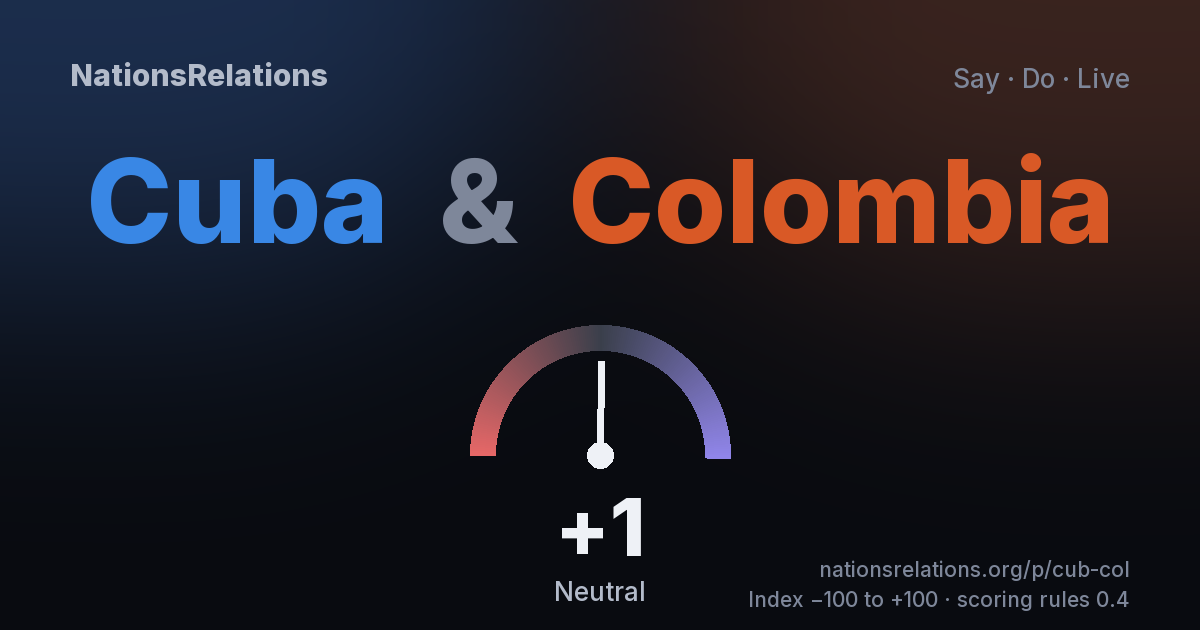
+1

哥伦比亚

关于古巴的31句 · 1946年以来 · 哥伦比亚概况
边界仅供参考方位,不表示对争议领土的任何立场。

虚线轮廓:地位有争议的地区。轮廓依据 Natural Earth,它对一些地区按公认边界绘制,对另一些地区按实际管辖方绘制;这些轮廓并不表明谁是正确的,也不显示当前战争的前线。

简而言之

  • 在联合国,双方的投票一致度为75% (2022–2024),低于两国各自与大多数国家的一致度。75%投票一致度
  • 商品贸易(每年US$7496.7万)对古巴一般,对哥伦比亚则远没那么重要。US$7496.7万每年
  • 在联合国,双方提及对方的频率大致相当(27句和31句)。27 · 31句子
  • 3,200名出生于古巴的人居住在哥伦比亚(联合国经社部按出生地统计,无论他们多久以前迁居)。3,200人
根据下方数据按固定规则撰写——没有AI。

指数是怎样算出的

每项得分从 −100 到 +100,按其权重计入。各部分相加即为指数。

联合国投票 35% -12 得分 -34 · 投票一致度75%高可信度
贸易 20% +9 得分 45 · 每年US$7496.7万高可信度
安全 30% 0 得分 0 · 未记录到两国政府之间的武装冲突高可信度
共同组织 15% +4 得分 25 · 1个共同组织高可信度
言辞–在有人核对立场标签之前不计分(已核对0/58)
指数+1
你看重什么?调整权重
解释这个分数每个数字如何构建,一步步说明

每个分数都遵循“工作原理”中写明的固定规则;不涉及AI。以下是这对国家的步骤,使用它自己的数字。 工作原理 · JSON · 下载 · 步骤为英文。

联合国投票 −34

  1. Votes are compared with each country's own voting partners, not with all pairs: most of the world votes alike, so a global ranking would make France–Germany +62 and Canada–United States +6.
  2. Among 古巴's 191 voting partners, 哥伦比亚 ranks 113 (1 is the closest). That is position 41 on a scale from 0 (the furthest partner) to 100 (the closest).
  3. Among 哥伦比亚's 191 voting partners, 古巴 ranks 144: position 25.
  4. The two positions are averaged (33) and stretched to the range −100 to +100: −34.

Inputs: Vote agreement 75% on recorded votes, 2022–2024 (the same vote counts 1, an abstention against a yes or a no ½).

贸易 45

  1. Trade is scored by how much the more dependent side relies on it: the larger of the two shares of total trade, here 1.23%.
  2. On a log scale, 0.1% or less scores 0 and 25% or more scores 100 (a percentile would make 0.1% of a country's trade look like a middling tie).
  3. (log10(1.23%) − log10(0.1%)) ÷ (log10(25%) − log10(0.1%)) × 100 = 45, kept between 0 and 100, so the score is 45.

Inputs: Goods trade both ways: US$7496.7万 a year, 2023–2025 (IMF) · 1.23% of 古巴's trade, 0.0682% of 哥伦比亚's.

安全 0

  1. No fighting on opposite sides is recorded in the last 30 years, so security can only push up.
  2. Not both in NATO: +0.
  3. No fighting side by side is recorded: +0.
  4. Sum 0, capped at 80: 0.

Inputs: Opposed: never. Data to 2025. · Not both NATO members.

共同组织 25

  1. Each tracked group both belong to adds 25, and so does the same UN regional group. Capped at 100.
  2. 0 shared groups + the same regional group (GRULAC) = 1 × 25 = 25.

Inputs: Tracked groups: EU, AU, ARAB, ASEAN, BRICS, G7, G20, GCC, P5.

指数 +1

分数数值权重计入增加
联合国投票−343535%−11.9
贸易452020%+9.0
安全03030%+0.0
共同组织251515%+3.8

指数是现有分数的加权平均:(35×(−34) + 20×45 + 30×0 + 15×25) ÷ 100 = +0.8,显示为+1。标签:55及以上 非常接近,25 接近,0 中立,−30 疏远,以下 对立。上面的权重可以自行调整。

言辞(双方如何谈论对方)会显示但不计分,人员层面(移民、难民、足球)也从不计分。

我们有多确定?每个数字背后有多少数据

分数的可靠程度取决于其背后的数据。共四级:高、中、低、无。阈值写在“工作原理”中;等级不改变分数,只说明可以信任到什么程度。 工作原理

联合国投票高2022–2024年(核心比例涵盖的年份)共有272次全文共同投票。有这么多次,比例的精度约为±6个百分点。
贸易高2023–2025年这3年中有3年报告了商品贸易。仅商品,来自海关数据(IMF);不含服务和能源管道。
安全高乌普萨拉冲突数据项目涵盖截至2025年的所有国家。它只统计每年战斗死亡至少25人的冲突。
共同组织高跟踪的组织列表是固定的;成员资格经人工核对。
指数高可信度取决于两个必需部分(投票和贸易)中较弱的一个。安全和共同组织会增加指数,但从不提高可信度。

它们的投票立场真的不同吗?

2025年,在联合国投票的主维度上,古巴位于−1.47(90%区间−1.86至−1.09),哥伦比亚位于−0.39(−0.62至−0.18)。差距为1.08。 它们的90%区间不重叠:在这个维度上两者明显不同。

立场是 Bailey、Strezhnev 和 Voeten 的理想点,根据所有记录投票估计;数值越高,投票越像美国和西方民主国家。这不是道德评分。

言辞(双方如何谈论对方)只计数、不计分,因此没有等级。重要时刻和人员层面是背景信息,从不计入分数。

01 · 来龙去脉

八十年,一条线

他们在联合国的投票有多相近(投票一致度)。色带是从数据本身发现的时期;圆点是重要时刻;下方是各国的领导人。

大会对全文的记录表决中的投票一致度:投票相同计1,弃权对赞成或反对计½,赞成对反对计0。来源:Nations on Record(Voeten等人的一致度分数;联合国数字图书馆)。

1946–1958
80%
投票一致度
1959–1975
56%
比以前更远
1976–2024
85%
比以前更近

来自数据

1946哥伦比亚首次在联合国一般性辩论讲话中提到古巴。
1950古巴首次在联合国一般性辩论讲话中提到哥伦比亚。
1959联合国投票一致率的最大下降:从1949–1958年的81%一致降至1959–1969年的48%。
2021两国有记录以来最高的货物贸易额(经通胀调整):双向US$1.2亿,按2025年美元计(按当时美元计为US$1亿)。
按照对所有国家组合都相同的四条固定规则从数据中找出,并非编辑挑选。从不计入任何得分。 规则
  • 投票:该年之前十年与该年起十年的投票一致度相差最大的年份,前提是差距至少15个百分点。
  • 武装冲突:UCDP记录两国处于对立双方的每一段连续年份。
  • 贸易:按美国消费者价格(BLS)进行通胀调整后,双向货物贸易额最高的年份,前提是至少有五年的贸易记录。
  • 讲话:两国各自在联合国一般性辩论讲话中首次提到对方的年份,从两国都在联合国投票的第一年起算(此前,一个名称可能指某个地区或尚未独立的国家)。

02 · 言

他们自己的话

它们从未真正进行过的对话:每个十年,各国政府在联合国一般性辩论发言中如何谈论对方。

1940年代
In addition, it wishes to express the real pleasure with which it noted the attitude adopted by the Under-Secretary for Foreign Affairs of the Soviet Union, Mr. Vyshinsky, in facilitating the discussion of Cuba’s motion on the veto, although he regarded it as inconvenient and inopportune for his Government. Mr. Lopez · 哥伦比亚 · 1946
1950年代
It not only fought against the veto with all its might at San Francisco, but Cuba and Colombia were the only nations which voted against its acceptance. Mr. DIHIGO Y LOPEZ TRIGO · 古巴 · 1950
1960年代
In fact, in many countries the growth-rate has been negligible: Argentina 1.1 per cent, Brazil 0.7 per cent, Paraguay 0.52 per cent, Venezuela, Colombia, Ecuador, Costa Rica and Chile below 2 per cent per year; and in others the economy has regressed: Haiti -2.9 per cent, the Dominican Republic -1.3 per cent, Uruguay -0.1 per cent. Mr. ROA · 古巴 · 1967
He was referring to the need for his country to discuss the problems of South-East Asia with the People’s Republic of China, the advisability of reaching an agreement on the dismantling of the Warsaw Treaty and the North Atlantic Treaty Organization, and the readmission of the Republic of Cuba to the American community of nations. Mr. LOPEZ MICHELSEN · 哥伦比亚 · 1968
1970年代
The Heads of State or Government also stressed something new in Latin American relations, something that sets an example to other regions of the world, namely the way in which the Governments of Panama, Costa Rica and Mexico, as well as the member countries of the sub regional Andean Pact, Bolivia, Colombia, Ecuador, Peru and Venezuela, acted in unison and solidarity to achieve a just solution to the Nicaraguan problem, as well as Cuba's traditional solidarity with the cause of that people. Castro, President of the Council of State and of the Government · 古巴 · 1979
1980年代
If we were to mention all United States interventions in Latin America - from Mexico to Argentina, from Cuba to Grenada, from the Dominican Republic and Haiti to Colombia and should we include the regimes installed or kept in power through open imperialist intervention, the map of the continent would be filled in without exception. Mr. HALMIERCA PBOLI · 古巴 · 1986
I did the same in October 1985 in letters I addressed to Fidel Castro, President of Cuba, end Aldwin Clausen, President of the World Bank, with regards to the Assembly to be held in Seoul. Mr. BARCO VARGAS, President · 哥伦比亚 · 1986
1990年代
Before the end of this century, we shall have to strive to resolve peacefully the most important conflict to outlive the cold war: the conflict with the brotherly Republic of Cuba. Mr. Ernesto Samper Pizano, President · 哥伦比亚 · 1994
2000年代
Since the last Colombian Government, we have sought, through Cuba, on the one hand, and several additional Governments on the other, a peace process with the National Liberation Army (ELN). Alvaro Uribe Vélez, President · 哥伦比亚 · 2003
2010年代
Cuba will continue to contribute to the extent possible, and at the request of the parties involved, to efforts to achieve a stable and lasting peace in Colombia. Mr. Bruno Eduardo Rodríguez Parrilla, Minister for Foreign Affairs · 古巴 · 2017
Their weapons will be melted and will be made into three monuments to peace — one here in New York; one in Cuba, where the peace negotiations took place; and another one in Colombia. Mr. Juan Manuel Santos Calderón, President · 哥伦比亚 · 2016
2020年代
Cuba remains committed to peace in Colombia, and we feel solidarity with President Gustavo Petro today. Bruno Eduardo Rodríguez Parrilla, Minister for Foreign Affairs · 古巴 · 2025
That is something different, and we are grateful to the countries that have helped us, such as Qatar, Cuba, Mexico, Vatican, Norway, Brazil, and Venezuela. Gustavo Petro Urrego, President · 哥伦比亚 · 2025

引语规则:每个十年,取该十年最后一次发言中一方提及另一方的第一句话。所有国家对和双方都适用同一规则。

谁在谈论谁

古巴哥伦比亚

名字旁边的词

当古巴发言时

对话3
团结2
侵略1

当哥伦比亚发言时

感谢3
核2
对话2
侵略2
制裁1
团结1

同一句话中的关键词,而不是对谁做了什么的判断。

03 · 行

投票、贸易、战争与同盟

逐个议题

在“核武器”上最相似(96%投票相同),在“人权”上相距最远(74%),2010年以来所有投票为86%。

殖民主义:投票一致度从85%(2010–14)降至67%(2015–19)。

  • 所有记录表决 86% (区间 84–88%) 2010年以来,1452次投票 · 所有年份85% 2010–14: 75% 2015–19: 76% 2020–25: 80%
  • 裁军 89% (区间 84–93%) 2010年以来,174次投票 · 所有年份85% 2010–14: 78% 2015–19: 79%
  • 中东 87% (区间 81–91%) 2010年以来,193次投票 · 所有年份90% 2010–14: 80% 2015–19: 76% 2020–25: 75%
  • 人权 74% (区间 68–79%) 2010年以来,246次投票 · 所有年份81% 2010–14: 62% 2015–19: 60% 2020–25: 54%
  • 殖民主义 89% (区间 81–94%) 2010年以来,96次投票 · 所有年份90% 2010–14: 85% 2015–19: 67%
  • 核武器 96% (区间 93–98%) 2010年以来,198次投票 · 所有年份87% 2010–14: 94% 2015–19: 92% 2020–25: 92%
  • 经济发展 84% (区间 75–90%) 2010年以来,95次投票 · 所有年份86% 2010–14: 68% 2015–19: 76%

记录表决中的投票一致度,逐票计算,规则与主要数字相同:投票相同计1,弃权对赞成或反对计½,赞成对反对计0。修正案和单独段落的投票不计在内。议题是联合国投票数据集的标签;一项决议可以有多个标签,约60%没有标签。裁军、殖民主义和经济发展自2019年起合并编码,因此只统计到2018年的投票。 柱条:2010–2025;标记:所有年份。比例至少需要五次共同投票。每根柱条上的细线是按投票次数计算的95%抽样区间。

使它们分开的投票

自2010年以来,它们共同参与了1452项全文决议表决。其中77项一方赞成另一方反对;329项在某方面有所不同。 最新的10项,最新在前: (API最多列出50个: API)

2010年以来联合国大会对全文的记录表决;与议题柱条一样,修正案和单独段落不计在内。标题和文件编号:联合国数字图书馆,经由 Nations on Record;投票:Voeten 等。投票并不表达对另一国的看法,只针对文本。

投票立场随时间的变化

每年在联合国投票主维度上的位置及其90%区间。阴影区间重叠的年份,当年的投票无法区分两国。 差距在1946年为2.08,在2025年为1.08;1961年最大(3.76)。

-4.0-3.0-2.0-1.00+1.0+2.0+3.0 19501960197019801990200020102020

古巴 哥伦比亚

显示数据表
年份古巴90%区间哥伦比亚90%区间
2025-1.47-1.86 – -1.09-0.39-0.62 – -0.18
2024-1.37-1.6 – -1.13-0.23-0.38 – -0.1
2023-1.11-1.31 – -0.91-0.16-0.32 – -0.01
2022-1.28-1.5 – -1.08-0.02-0.16 – 0.11
2021-1.54-1.85 – -1.23-0.02-0.16 – 0.11
2020-1.52-1.86 – -1.180.02-0.11 – 0.15
2019-1.47-1.83 – -1.150.04-0.09 – 0.17
2018-1.6-1.93 – -1.27-0.09-0.23 – 0.04
2017-1.72-2.09 – -1.33-0.23-0.41 – -0.07
2016-1.77-2.13 – -1.42-0.18-0.37 – -0.01
2015-1.71-2.11 – -1.31-0.14-0.31 – 0.01
2014-1.68-2.03 – -1.34-0.17-0.35 – 0.0
2013-1.62-2.03 – -1.23-0.11-0.29 – 0.06
2012-1.62-1.95 – -1.3-0.06-0.23 – 0.11
2011-1.71-2.05 – -1.36-0.06-0.22 – 0.09
2010-1.38-1.76 – -0.99-0.13-0.32 – 0.03
2009-1.43-1.81 – -1.07-0.14-0.3 – 0.03
2008-1.19-1.56 – -0.83-0.19-0.37 – -0.03
2007-1.19-1.59 – -0.8-0.13-0.3 – 0.02
2006-1.04-1.4 – -0.69-0.25-0.42 – -0.1
2005-1.3-1.71 – -0.92-0.47-0.7 – -0.27
2004-1.14-1.58 – -0.72-0.44-0.71 – -0.19
2003-1.33-1.76 – -0.92-0.23-0.43 – -0.04
2002-0.94-1.32 – -0.59-0.23-0.42 – -0.05
2001-1.11-1.49 – -0.77-0.3-0.53 – -0.08
2000-1.12-1.49 – -0.72-0.3-0.54 – -0.08
1999-1.38-1.73 – -1.03-0.36-0.6 – -0.14
1998-1.5-1.96 – -1.05-0.63-0.97 – -0.3
1997-1.92-2.31 – -1.55-0.69-1.0 – -0.41
1996-2.0-2.41 – -1.61-0.61-0.92 – -0.32
1995-1.91-2.32 – -1.57-0.52-0.82 – -0.24
1994-1.53-1.95 – -1.18-0.61-0.97 – -0.29
1993-1.71-2.15 – -1.31-0.48-0.77 – -0.18
1992-1.61-2.03 – -1.2-0.39-0.64 – -0.14
1991-1.81-2.23 – -1.39-0.55-0.88 – -0.22
1990-1.54-2.07 – -0.98-0.57-0.95 – -0.23
1989-1.11-1.54 – -0.71-0.15-0.4 – 0.08
1988-1.34-1.68 – -1.020.190.05 – 0.34
1987-1.4-1.68 – -1.130.11-0.06 – 0.27
1986-1.35-1.61 – -1.080.20.06 – 0.34
1985-1.53-1.83 – -1.270.240.1 – 0.36
1984-1.48-1.79 – -1.190.14-0.0 – 0.27
1983-1.3-1.53 – -1.10.14-0.01 – 0.27
1982-1.3-1.52 – -1.10.150.0 – 0.29
1981-1.43-1.69 – -1.180.210.06 – 0.34
1980-1.39-1.64 – -1.140.370.21 – 0.52
1979-1.15-1.36 – -0.950.05-0.16 – 0.24
1978-1.46-1.7 – -1.220.430.24 – 0.59
1977-1.68-2.01 – -1.380.450.26 – 0.63
1976-1.57-1.92 – -1.230.270.04 – 0.51
1975-1.72-2.08 – -1.360.650.44 – 0.85
1974-2.12-2.65 – -1.570.730.52 – 0.95
1973-2.05-2.54 – -1.560.60.36 – 0.83
1972-1.76-2.22 – -1.330.720.47 – 0.96
1971-1.76-2.16 – -1.360.530.27 – 0.79
1970-1.72-2.27 – -1.210.630.38 – 0.9
19690.360.01 – 0.70.990.53 – 1.48
1968-0.19-0.67 – 0.240.680.36 – 1.01
1967-0.76-1.41 – -0.140.640.22 – 1.02
1966-2.5-3.33 – -1.760.780.38 – 1.19
1965-2.76-3.41 – -2.090.820.48 – 1.15
1963-3.08-3.7 – -2.410.660.23 – 1.06
1962-2.44-2.99 – -1.891.10.8 – 1.43
1961-2.61-3.1 – -2.131.150.82 – 1.48
1960-1.17-1.71 – -0.631.41.05 – 1.78
19590.23-0.15 – 0.621.270.86 – 1.67
19581.220.73 – 1.731.150.67 – 1.65
19571.140.79 – 1.491.360.99 – 1.77
19561.130.59 – 1.661.050.46 – 1.59
19551.490.66 – 2.341.710.87 – 2.56
19541.130.51 – 1.721.781.09 – 2.49
19530.70.24 – 1.161.671.22 – 2.11
19520.670.31 – 1.030.880.49 – 1.26
19510.19-0.46 – 0.830.760.09 – 1.44
1950-0.08-0.7 – 0.550.70.19 – 1.21
19490.49-0.02 – 0.990.850.31 – 1.42
19480.16-0.37 – 0.680.46-0.09 – 0.98
19470.910.47 – 1.360.18-0.31 – 0.64
19461.170.55 – 1.86-0.92-1.38 – -0.52

立场是 Bailey、Strezhnev 和 Voeten 的理想点,根据所有记录投票估计;数值越高,投票越像美国和西方民主国家。这不是道德评分。 来源:Nations on Record(Bailey、Strezhnev 和 Voeten)。

联合国投票地图上

2020–24,古巴与中国、俄罗斯等7国一起投票(共10个国家),哥伦比亚与巴西、墨西哥等32国一起投票(35个)。 自1946年以来的8个时期中,有1个时期两国同属一个集团。

正在加载地图……

拖动年份,查看各集团自1946年以来的变化。

每个圆点是一个国家,按该年投票的相似程度摆放:靠得近的国家投票相似。颜色表示投票集团,即该时期彼此互为最接近投票伙伴的一组国家。坐标轴没有单位;美国始终在右侧,中国在上方。 点击一个圆点,打开该国与古巴的国家对页面。 来源:Nations on Record,可查看完整的集团信息。 集团内部(Nations on Record). 从不计入分数。

共同的朋友

在联合国与各自投票最相似的国家。中间的国家与两者投票都相似。

贸易随时间变化

古巴对哥伦比亚出口哥伦比亚对古巴出口

商品出口,现价美元。IMF,经由 Nations on Record。

谁需要谁

箭头宽度:每个方向的年度商品流量(2023–2025)。柱条:占各国贸易总额的比例。

安全

自1946年以来,未记录到两国政府之间的武装冲突,也未记录到并肩作战。

计入:两国政府处于对立两方,或一方派兵与另一方作战。与驻在对方国家的武装团体之间的战斗不计入。 UCDP 双边数据集 26.1,数据截至2025年。

共同组织

同一联合国区域组

欧盟、非洲联盟、阿拉伯国家联盟、东盟、金砖国家、七国集团、二十国集团、海湾合作委员会、五常及联合国区域组。北约计入安全。

贸易协定

两国共有2项通报世界贸易组织的贸易协定;最早的一项自1981年起生效。

已通报世界贸易组织的协定,已生效或已签署。当欧盟等集团作为一方签署时,协定把其成员与另一方联系起来,而不是成员彼此之间。 状态以通报世界贸易组织的内容为准;不核实协定目前是否仍在这两国之间适用。 来源:世界贸易组织区域贸易协定数据库。

制裁

两国均不受联合国制裁。两国自身可能相互实施的制裁不在此追踪。

联合国安理会、欧盟、美国和英国针对国家的制裁制度;不含专题清单(恐怖主义、网络、人权),也不含其他国家自己的清单。制裁制度可能针对政府、官员或企业;它不是衡量两国关系的指标。 来源:欧盟制裁地图、OFAC(美国财政部)、英国政府。 从不计入分数。

04 · 人

人与人之间

政府争吵;人们迁徙、求学、逃难、踢足球。这些都不计入指数。

居住在对方国家

出生于古巴出生于哥伦比亚

国际移民存量,联合国经社部2024。 按出生地统计:包括难民,以及在现有边界形成之前出生的人,例如出生在后来分裂的国家。

难民与寻求庇护者
769
来自古巴,在哥伦比亚 (2025)
5
来自哥伦比亚,在古巴 (2011)

联合国难民署。仅限难民和寻求庇护者:抵达时获得公民身份的人不计入。

询问古巴和哥伦比亚本地AI · 只根据本页数据回答 · 数字经过核对 · 以英文回答

回答由人工智能语言模型撰写,而非网站编辑。它可能出错;以本页的数字和来源为准。

近期变化

  • 共同投票:大致不变(2022–2024年为75%)。
  • 贸易:上升37%(每年US$5468.9万 → US$7496.7万)。
  • 在联合国相互提及的句子:最近五次一般性辩论中 7 句,此前五次中 4 句。

来源与覆盖范围

  • 发言、提及、投票、贸易: Nations on Record, 带倾向 2026-10-12 20:33 UTC.
  • UCDP Dyadic and Battle-Related Deaths datasets, version 26.1, loaded 2026-11-14 20:06 UTC.
  • UN DESA International Migrant Stock 2024, loaded 2026-10-12 20:18 UTC. UNHCR Refugee Population Statistics (api.unhcr.org), 2000–2025, loaded 2026-10-12 20:18 UTC.
  • International football results 1872–present (Mart Jürisoo, CC0), loaded 2026-10-12 20:18 UTC.
  • 计分规则 0.4 (14 Nov 2026), 已计算分数 2026-11-14 21:20 UTC. 全部规则.