Morocco

134 sentences about Algeria · since 1946 · Morocco profile
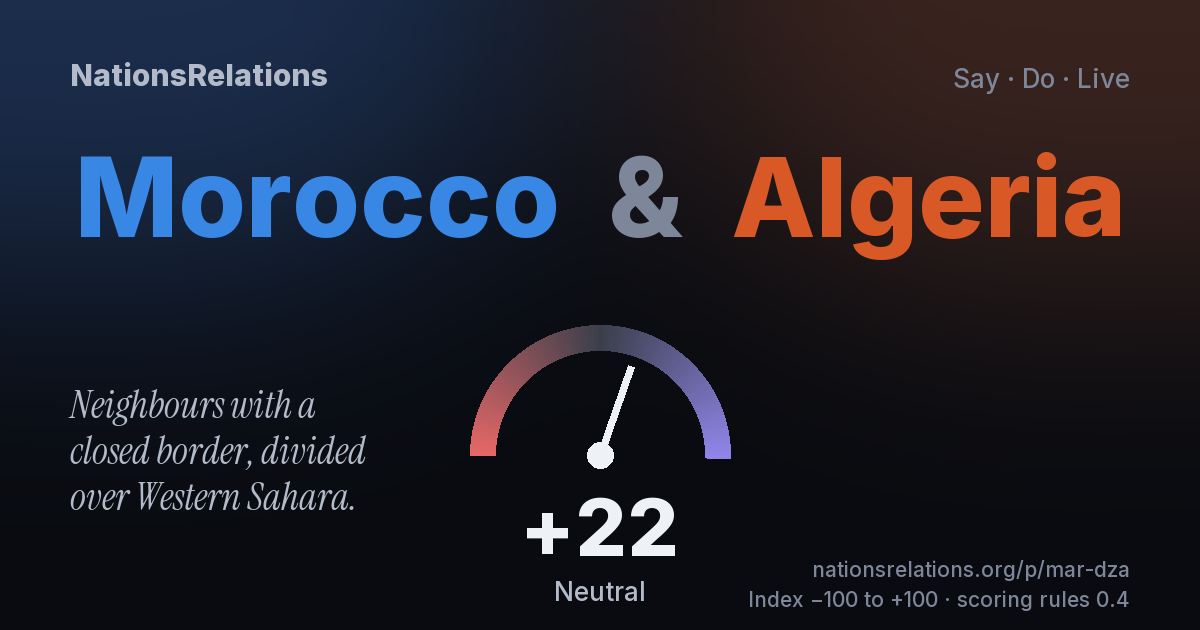
+22

Algeria

57 sentences about Morocco · since 1946 · Algeria profile

Neighbours with a closed border, divided over Western Sahara.

Borders are for orientation only and say nothing about disputed territory.

Dashed outlines: areas whose status is disputed. Shapes follow Natural Earth, which draws some areas along recognised borders and others by who administers them on the ground; they say nothing about who is right, and front lines of current wars are not shown.

In short

  • Armed conflict: UCDP records them on opposite sides, as main parties, in 1963. They were also on opposite sides of a later conflict, most recently in 1976.Opposite sides
  • At the UN their vote agreement is 92% (2022–2024), higher than either of them has with most countries.92%vote agreement
  • Trade in goods ($57 million a year) is a very small part of either country's trade, under 0.5%.$57 milliona year
  • In its UN General Debate speeches, Morocco names Algeria more often than the reverse (134 sentences against 57).134 · 57sentences
  • 16,000 people born in Algeria live in Morocco (UN DESA counts place of birth, however long ago they moved).16,000people
Written by fixed rules from the data below — no AI.

How the index is built

Each score runs from −100 to +100 and counts by its weight. The parts add up to the index.

UN votes 35% +11 score +31 · Vote agreement 92%High confidence
Trade 20% 0 score 0 · $57 million a yearHigh confidence
Security 30% 0 score 0 · Opposite sides of armed conflict, last in 1976: too long ago to count under the rulesHigh confidence
Shared clubs 15% +11 score 75 · 3 shared groupsHigh confidence
Words–Not scored until people check the stance labels (0 of 191 checked)
Index+22
What matters to you? Adjust the weights
Explain this scorehow each number is built, step by step

Every score follows fixed rules written out on How it works; no AI is involved. Here are the steps for this pair, with its own numbers. How it works · JSON · Downloads

UN votes +31

  1. Votes are compared with each country's own voting partners, not with all pairs: most of the world votes alike, so a global ranking would make France–Germany +62 and Canada–United States +6.
  2. Among Morocco's 191 voting partners, Algeria ranks 92 (1 is the closest). That is position 52 on a scale from 0 (the furthest partner) to 100 (the closest).
  3. Among Algeria's 191 voting partners, Morocco ranks 42: position 78.
  4. The two positions are averaged (65) and stretched to the range −100 to +100: +31.

Inputs: Vote agreement 92% on recorded votes, 2022–2024 (the same vote counts 1, an abstention against a yes or a no ½).

Trade 0

  1. Trade is scored by how much the more dependent side relies on it: the larger of the two shares of total trade, here 0.0575%.
  2. On a log scale, 0.1% or less scores 0 and 25% or more scores 100 (a percentile would make 0.1% of a country's trade look like a middling tie).
  3. (log10(0.0575%) − log10(0.1%)) ÷ (log10(25%) − log10(0.1%)) × 100 = −10, kept between 0 and 100, so the score is 0.

Inputs: Goods trade both ways: $57 million a year, 2023–2025 (IMF) · 0.043% of Morocco's trade, 0.0575% of Algeria's.

Security 0

  1. The Uppsala Conflict Data Program records the two on opposite sides of armed conflict. Each kind has a weight (main parties 100, troops 60, proxy 30) that fades with time: ×1 within 4 years of the last data year, ×0.5 for 5 to 14 years, ×0.2 for 15 to 29, 0 after that.
  2. As main parties, last in 1963: 100 × 0 = 0
  3. One a main party, the other sending troops, last in 1976: 60 × 0 = 0
  4. The largest counts: +0. Recent fighting on opposite sides outweighs any alliance.

Inputs: Opposed: direct 1976, primary 1963. Data to 2025. · Not both NATO members.

Shared clubs 75

  1. Each tracked group both belong to adds 25, and so does the same UN regional group. Capped at 100.
  2. 2 shared groups (ARAB, AU) + the same regional group (AFR) = 3 × 25 = 75.

Inputs: Tracked groups: EU, AU, ARAB, ASEAN, BRICS, G7, G20, GCC, P5.

Index +22

ScoreValueWeightCounts forAdds
UN votes313535%+10.8
Trade02020%+0.0
Security03030%+0.0
Shared clubs751515%+11.2

The index is the weighted average of the scores that exist: (35×31 + 20×0 + 30×0 + 15×75) ÷ 100 = +22.1, shown as +22. Labels: 55 and up Very close, 25 Close, 0 Neutral, −30 Distant, below Opposed. Weights are yours to change above.

Words (what the two say about each other) are shown but not scored, and the people layer (migration, refugees, football) never is.

How sure are we?how much data stands behind each number

A score is only as good as the data under it. Four levels: High, Medium, Low, None. The thresholds are written on How it works; the level does not change a score, it tells you how far to trust it. How it works

UN votesHigh253 shared votes on whole texts in 2022–2024, the years the headline share covers. With that many, a share is good to about ±6 points.
TradeHighGoods trade is reported in 3 of the 3 years 2023–2025. Goods only, from customs data (IMF); services and energy pipelines are not in it.
SecurityHighThe Uppsala Conflict Data Program covers every state up to 2025. It counts only conflicts with at least 25 battle deaths a year.
Shared clubsHighThe list of tracked groups is fixed; membership is checked by hand.
IndexHighAs sure as the weaker of its two required parts, votes and trade. Security and shared clubs add to it but never make it surer.

Do their voting positions really differ?

In 2025, Morocco stood at −0.43 (90% range −0.69 to −0.21) and Algeria at −0.89 (−1.19 to −0.62) on the main dimension of UN voting. The gap is 0.46. Their 90% ranges overlap: from their votes alone we cannot tell the two positions apart.

Positions are the ideal points of Bailey, Strezhnev and Voeten, estimated from every recorded vote; higher means voting more like the United States and Western democracies. They are not a moral score.

Words (what the two say about each other) are counted, not scored, so they carry no level. Moments and the people layer are context and never enter a score.

01 · The story so far

Eighty years, one line

How closely they voted at the UN (vote agreement). Bands are eras found in the data itself; dots are moments; below, who led each country.

Vote agreement on recorded General Assembly votes on whole texts: the same vote counts 1, an abstention against a yes or a no ½, a yes against a no 0. Source: Nations on Record (agreement score of Voeten et al.; UN Digital Library).

1962–1986
90%
vote agreement
1987–2014
96%
Closer than before
2015–2024
92%
Steady

Moments

Sand War over the border
Unknown author · CC0
1963Sand War over the borderbackground
Green March; under the Madrid Accords Spain hands Western Sahara's administration to Morocco and Mauritania; the Algeria-backed Polisario Front contests Morocco's claim
Flaggingwill · CC BY-SA 4.0
1975Green March; under the Madrid Accords Spain hands Western Sahara's administration to Morocco and Mauritania; the Algeria-backed Polisario Front contests Morocco's claimbackground
1976Morocco breaks off relations after Algeria recognises the Sahrawi Arab Democratic Republicbackground
1988Diplomatic relations restoredbackground
1994The land border closes after a hotel attack in Marrakesh; it has stayed closed sincebackground
2021Algeria cuts diplomatic relationsbackground

Editorial context for this featured pair. Never part of a score.

From the data

1962The first time Morocco named Algeria in a UN General Debate speech.
1963UCDP records them on opposite sides of armed conflict in this year.
1973The first time Algeria named Morocco in a UN General Debate speech.
1976UCDP records them on opposite sides of armed conflict in this year.
2013Their highest recorded trade in goods, adjusted for inflation: $1.7 billion both ways in 2025 US dollars ($1.3 billion in the dollars of the time).
Found in the data by four fixed rules, the same for every pair, not chosen by an editor. Never part of a score. The rules
  • Voting: the year with the biggest difference in vote agreement between the ten years before it and the ten years from it, if that difference is at least 15 points.
  • Armed conflict: every period of consecutive years in which UCDP records the two on opposite sides.
  • Trade: the year with the highest trade in goods both ways, adjusted for inflation with US consumer prices (BLS), if trade is recorded in at least five years.
  • Speeches: for each of the two, the first year it named the other in its UN General Debate speech, counted from the first year both voted at the UN (before that, a name can mean a territory or a state not yet independent).

02 · Say

In their own words

The conversation they never quite had: for each decade, what each government said about the other in its UN General Debate speech.

1950s
The situation on the eastern frontier remains equally confused, for the war which has been raging in Algeria for the last five years is not only being used as a pretext for the indefinite postponement of the problem of delimitation but is also giving rise to many grave incidents and even to the occupation by the French army of Moroccan territory, as in the case of Hassi-Zerzour at the end of July 1959, which my Government brought to the attention of the United Nations. Mr. Benhima · Morocco · 1959
1960s
In this respect too, though in a regional context and in the interests of preserving the brotherly relations existing between Morocco and Algeria, my Government felt it opportune to put an end to the arms race in North Africa. Mr. LARAKI · Morocco · 1967
1970s
There is a Moroccan Sahara, as there is a Mauritanian Sahara, a Malian Sahara, an Algerian Sahara, a Tunisian Sahara and other Saharas belonging to every State bordering on this desert. Boucetta · Morocco · 1979
Noting that turn of events, the non-aligned movement, in the Final Declaration of the Sixth Conference, in Havana, unambiguously endorsed the right of the people of Western Sahara to self-determination and independence, and expressed its deep disapproval at the fact that Morocco had extended its military occupation. Benyahia · Algeria · 1979
1980s
The establishment of the Arab Maghreb Union, therefore, is an imperative, given the nature of the economic and social problems which face our countries, and whose solution requires joint efforts in a regional framework - the more so since current world trends point in the direction of regional integration as a means of standing up to the many challenges we face and as a necessary element for peace, harmony and stability The efforts begun by the five Maghreb Heads of State at their first summit meeting, held at Zeralda, were crowned with the signing, on 17 February 1989 at Marrakech of the Treaty establishing the Arab Maghreb Union comprising Algeria, Libya, Mauritania, Tunisia and Morocco. FILALI · Morocco · 1989
Therefore, Algeria profoundly welcomes the acceptance, last year, by Morocco and the POLISARIO Front of the joint proposals of the Chairman of the Organization of African Unity (OAU) and the Secretary-General of the United Nations, seeking to ensure the free and authentic exercise by the Sahraoui people of its right to self-determination and independence. GHOZALI · Algeria · 1989
1990s
Against this backdrop, an Arab mini-summit was held in Eabat on 19 September 1990 between His Majesty King Hussein of Jordan, His Majesty the King of Morocco and His Excellency President Benjedid of Algeria to seek a solution to the crisis. FILALI · Morocco · 1990
Like the rest of the international community, Algeria welcomes the Houston accord, through which the two parties to the conflict, the Kingdom of Morocco and the POLISARIO front, solemnly agreed on the practical modalities for implementing the provisions of the settlement plan under the auspices of the United Nations. Ahmed Attaf, Minister for Foreign Affairs · Algeria · 1998
2000s
His Majesty King Mohammad VI has reaffirmed Morocco’s strong and enduring resolve to contribute in good faith to the consolidation of the Arab Maghreb Union, the reactivation of its structures and the strengthening of relations among its members, including brotherly Algeria. Taib Fassi Fihri, Minister for Foreign Affairs · Morocco · 2009
We hope that the negotiations that began in June and resumed in August at New York will continue, in order to allow the two parties Morocco and the Frente POLISARIO to reach an agreement in line with international law that makes it possible for the people of Western Sahara to decide their own fate freely and without constraints in a referendum on self-determination. Mourad Medelci, Minister for Foreign Affairs · Algeria · 2007
2010s
That is why it is essential to work diligently to find a lasting political solution through efforts in which Algeria, if it is serious, should be effectively and directly involved, given its historical and political responsibility for creating, fuelling and prolonging the dispute. Mr. M Saad-Eddine El Othmani, Head of Government · Morocco · 2018
We hope that the spirit of dialogue will prevail between our brothers in the Kingdom of Morocco and the Frente Popular para la Liberacion de Saguia el-Hamra y de Rio de Oro so that they can reach a final solution that guarantees the ability of the people of the Sahara to exercise their legitimate right to self-determination, in accordance with the principles of the Charter of the United Nations and the relevant General Assembly and Security Council resolutions. Mr. Sabri Boukadoum, Minister for Foreign Affairs · Algeria · 2019
2020s
- No political process outside the framework of **UN-led round-table discussions**, with the full participation of Algeria. Aziz Akhannouch, Prime Minister · Morocco · 2024
Second, that the solution be based on direct negotiations between the parties, the Kingdom of Morocco and the Polisario Front. Ahmed Attaf, Minister of State · Algeria · 2025

Quote rule: for each decade, the first sentence in the latest speech of that decade in which one names the other. Same rule for every pair and both sides.

Who talks about whom

MoroccoAlgeria

Words next to the name

When Morocco speaks

dialogue9
occupation5
terrorism2
gratitude2
aggression1

When Algeria speaks

dialogue19
occupation3
aggression1
solidarity1

A keyword in the same sentence, not a judgement of who did what.

03 · Do

Votes, trade, war and alliance

Topic by topic

Overall agreement hides what separates two governments. Here it is counted per issue.

Colonialism: the vote agreement fell from 100% (2010–14) to 84% (2015–19).

  • All roll-call votes 95% (range 94–96%) since 2010, 1420 votes · 95% all years 2010–14: 91% 2015–19: 92% 2020–25: 91%
  • Disarmament 96% (range 92–98%) since 2010, 178 votes · 94% all years 2010–14: 91% 2015–19: 93%
  • Middle East 100% (range 98–100%) since 2010, 192 votes · 100% all years 2010–14: 100% 2015–19: 100% 2020–25: 100%
  • Human rights 90% (range 86–93%) since 2010, 240 votes · 91% all years 2010–14: 84% 2015–19: 87% 2020–25: 81%
  • Colonialism 95% (range 89–98%) since 2010, 98 votes · 96% all years 2010–14: 100% 2015–19: 84%
  • Nuclear weapons 97% (range 94–99%) since 2010, 200 votes · 95% all years 2010–14: 94% 2015–19: 94% 2020–25: 94%
  • Economic development 97% (range 92–99%) since 2010, 91 votes · 96% all years 2010–14: 95% 2015–19: 94%

Vote agreement on roll-call votes, counted vote by vote the same way as the headline figure: the same vote counts 1, an abstention against a yes or a no ½, a yes against a no 0. Votes on amendments and single paragraphs are left out. Topics are the labels of the UN voting dataset; one resolution can carry several, and about 60% carry none. Disarmament, colonialism and economic development are coded together from 2019, so they count votes up to 2018. Bar: 2010–2025; mark: all years. Shares need at least five shared votes. The thin line on each bar is the 95% sampling range given the number of votes.

Votes that set them apart

Since 2010 they voted on 1420 whole-text resolutions together. On 21 one said yes and the other no; they differed in some way on 123. The 10 newest, newest first: (the API lists up to 50: API)

Roll-call votes on whole texts at the UN General Assembly, since 2010; amendments and single paragraphs are left out, as in the topic bars. Titles and document symbols: UN Digital Library via Nations on Record; votes: Voeten et al. A vote is not a statement about the other country, only about the text.

Voting positions over time

Each year's position on the main dimension of UN voting, with its 90% range. Where the shaded ranges overlap, the votes of that year cannot tell the two apart. The gap was 0.22 in 1962 and is 0.46 in 2025; it was widest in 1967 (1.69).

-3.5-2.5-1.5-0.5+0.5 197019801990200020102020

Morocco Algeria

Show data table
YearMorocco90% rangeAlgeria90% range
2025-0.43-0.69 – -0.21-0.89-1.19 – -0.62
2024-0.46-0.64 – -0.29-0.93-1.12 – -0.74
2023-0.34-0.52 – -0.16-0.9-1.1 – -0.71
2022-0.43-0.65 – -0.22-1.0-1.19 – -0.81
2021-0.36-0.58 – -0.16-0.91-1.18 – -0.64
2020-0.57-0.85 – -0.32-0.9-1.18 – -0.62
2019-0.54-0.77 – -0.32-0.8-1.08 – -0.54
2018-0.48-0.7 – -0.27-0.84-1.09 – -0.59
2017-0.36-0.59 – -0.15-0.95-1.28 – -0.62
2016-0.63-0.92 – -0.34-1.28-1.63 – -0.94
2015-0.51-0.79 – -0.27-1.19-1.57 – -0.83
2014-0.66-0.93 – -0.38-0.9-1.19 – -0.6
2013-0.67-0.96 – -0.39-0.98-1.27 – -0.66
2012-0.58-0.86 – -0.35-0.92-1.23 – -0.63
2011-0.62-0.9 – -0.36-1.25-1.56 – -0.95
2010-0.51-0.79 – -0.27-1.2-1.55 – -0.84
2009-0.66-0.94 – -0.41-1.27-1.63 – -0.95
2008-0.61-0.88 – -0.37-1.12-1.44 – -0.8
2007-0.6-0.89 – -0.35-1.2-1.58 – -0.83
2006-0.73-1.04 – -0.45-1.2-1.57 – -0.83
2005-0.94-1.27 – -0.64-0.8-1.11 – -0.52
2004-0.96-1.39 – -0.59-1.0-1.39 – -0.65
2003-1.06-1.49 – -0.69-1.04-1.42 – -0.69
2002-1.04-1.42 – -0.68-1.11-1.5 – -0.74
2001-0.86-1.2 – -0.52-1.14-1.54 – -0.77
2000-0.48-0.75 – -0.23-1.13-1.53 – -0.74
1999-0.76-1.06 – -0.46-0.84-1.18 – -0.51
1998-0.74-1.1 – -0.39-0.71-1.08 – -0.38
1997-0.67-0.99 – -0.38-0.82-1.14 – -0.49
1996-0.66-1.0 – -0.33-0.93-1.27 – -0.61
1995-0.17-0.4 – 0.08-0.87-1.23 – -0.56
1994-0.1-0.38 – 0.16-0.9-1.26 – -0.55
1993-0.86-1.27 – -0.45-0.71-1.06 – -0.38
1992-0.63-1.0 – -0.29-0.74-1.09 – -0.4
1991-0.77-1.16 – -0.39-1.06-1.47 – -0.65
1990-0.67-1.07 – -0.27-0.8-1.25 – -0.4
1989-0.4-0.75 – -0.12-0.95-1.34 – -0.57
1988-0.35-0.61 – -0.11-1.08-1.43 – -0.75
1987-0.25-0.5 – -0.03-1.19-1.46 – -0.93
1986-0.1-0.28 – 0.07-1.06-1.32 – -0.8
1985-0.21-0.4 – -0.04-0.91-1.11 – -0.7
1984-0.05-0.22 – 0.11-0.78-1.01 – -0.56
19830.02-0.14 – 0.18-0.67-0.89 – -0.46
19820.03-0.11 – 0.17-0.63-0.83 – -0.42
19810.06-0.11 – 0.22-0.71-0.96 – -0.49
19800.180.01 – 0.35-0.73-0.95 – -0.5
19790.240.06 – 0.41-0.77-1.02 – -0.52
1978-0.05-0.3 – 0.2-0.59-0.85 – -0.31
19770.04-0.24 – 0.31-0.33-0.7 – 0.0
1976-0.23-0.58 – 0.12-0.51-0.9 – -0.13
19750.12-0.16 – 0.38-0.6-1.0 – -0.25
19740.05-0.28 – 0.34-0.74-1.26 – -0.25
1973-0.19-0.68 – 0.25-0.62-1.1 – -0.17
1972-0.1-0.54 – 0.29-0.86-1.3 – -0.43
1971-0.29-0.7 – 0.13-0.74-1.19 – -0.3
1970-0.6-1.08 – -0.14-1.55-2.12 – -0.98
1969-0.66-1.22 – -0.08-2.01-2.78 – -1.26
1968-0.3-0.81 – 0.18-1.83-2.5 – -1.18
1967-0.65-1.2 – -0.14-2.34-3.11 – -1.62
1966-0.32-0.86 – 0.18-1.97-2.66 – -1.32
1965-0.58-1.14 – -0.08-1.86-2.48 – -1.23
1963-0.64-1.14 – -0.11-1.0-1.57 – -0.47
1962-1.23-1.73 – -0.73-1.02-1.6 – -0.41

Positions are the ideal points of Bailey, Strezhnev and Voeten, estimated from every recorded vote; higher means voting more like the United States and Western democracies. They are not a moral score. Source: Nations on Record (Bailey, Strezhnev and Voeten).

On the UN voting map

In 2020–24, Morocco voted with Yemen, Saudi Arabia and 5 others (8 countries in all) and Algeria with India, Indonesia and 60 others (63). They shared a bloc in 4 of the 7 periods since 1946.

Loading the map…

Drag the year to see how the blocs changed since 1946.

Each dot is a country, placed by how alike it voted that year: close dots voted alike. Colours are voting blocs, groups of countries among each other's closest voting partners in that period. The axes have no units; the United States is kept on the right and China at the top. Click a dot to open that country's pair with Morocco. Source: Nations on Record, which shows the blocs in full. Inside the blocs (Nations on Record). Never part of a score.

Friends in common

The countries each one votes most alike with at the UN. Countries in the middle vote alike with both.

Trade over time

Morocco sells to AlgeriaAlgeria sells to Morocco

Goods exports, current US dollars. IMF via Nations on Record.

Who needs whom

Arrow width: yearly goods flow in each direction (2023–2025). Bars: share of each country's total trade.

Security

  • 1976Morocco — opposite sides; one supporting another party with troops
  • 1963Algeria, Morocco — opposite sides, both main parties

Counted: the two governments on opposite sides, or one sending troops to fight against the other. Fighting with armed groups based in the other country is not counted. UCDP Dyadic Dataset 26.1, data to 2025.

Shared clubs

Arab LeagueAfrican Unionsame UN regional group

EU, African Union, Arab League, ASEAN, BRICS, G7, G20, GCC, the P5 and UN regional groups. NATO counts under Security.

Lives lost

Fighting between them before 1989 is not in this count, because UCDP's death figures begin that year. It is not zero.

ConflictYearsDeaths (best estimate)
Algeria, Morocco1963not counted (before 1989)

UCDP Battle-Related Deaths Dataset 26.1. Estimates; all parties to the dyad. Only deaths in fighting between the parties: civilians killed outside the fighting (UCDP's one-sided violence) and deaths from hunger, disease or lack of care are not in it.

Trade agreements

They share 2 trade agreements notified to the WTO; the first in force since 1989.

Agreements notified to the WTO, in force or signed. When a bloc such as the EU signs as one party, the agreement links its members with the other side, not with each other. The status is as notified to the WTO; whether an agreement is still applied between these two countries is not checked. Source: WTO Regional Trade Agreements database.

Sanctions

No UN sanctions apply to either. Sanctions the two countries may impose on each other themselves are not tracked here.

Country regimes of the UN Security Council, the EU, the United States and the United Kingdom; thematic lists (terrorism, cyber, human rights) are left out, and so are other countries' own lists. A regime can target a government, officials or companies; it is not a measure of the relationship. Sources: EU Sanctions Map, OFAC (US Treasury), UK government. Never part of a score.

04 · Live

Between people

Governments argue; people move, study, flee and play football. None of this enters the index.

Living in the other country

born in Algeria

UN DESA gives no figure for people born in Morocco living in Algeria.

International migrant stock, UN DESA 2024. By place of birth: this includes refugees, and people born before today's borders, for example in a state that later split.

Refugees & asylum seekers
5
from Morocco in Algeria (2025)
62
from Algeria in Morocco (2025)

UNHCR. Refugees and asylum seekers only: people given citizenship on arrival are not counted.

Ask about Morocco & AlgeriaLocal AI · answers only from this page's data · numbers checked

The answers are written by an AI language model, not by the site's editors. It can be wrong; the numbers and sources on this page are the reference.

What changed recently

  • Voting together: about the same (92% in 2022–2024).
  • Trade: down 88% ($480 million → $57 million a year).
  • Sentences naming each other at the UN: 13 in the last five General Debates, 5 in the five before.

Sources & coverage

  • Speeches, mentions, votes, trade: Nations on Record, loaded 2026-10-12 20:33 UTC.
  • UCDP Dyadic and Battle-Related Deaths datasets, version 26.1, loaded 2026-11-14 20:06 UTC.
  • UN DESA International Migrant Stock 2024, loaded 2026-10-12 20:18 UTC. UNHCR Refugee Population Statistics (api.unhcr.org), 2000–2025, loaded 2026-10-12 20:18 UTC.
  • International football results 1872–present (Mart Jürisoo, CC0), loaded 2026-10-12 20:18 UTC.
  • Scoring rules 0.4 (14 Nov 2026), scores built 2026-11-14 21:20 UTC. Every rule.