Mexico

133 sentences about the United States · since 1946 · Mexico profile
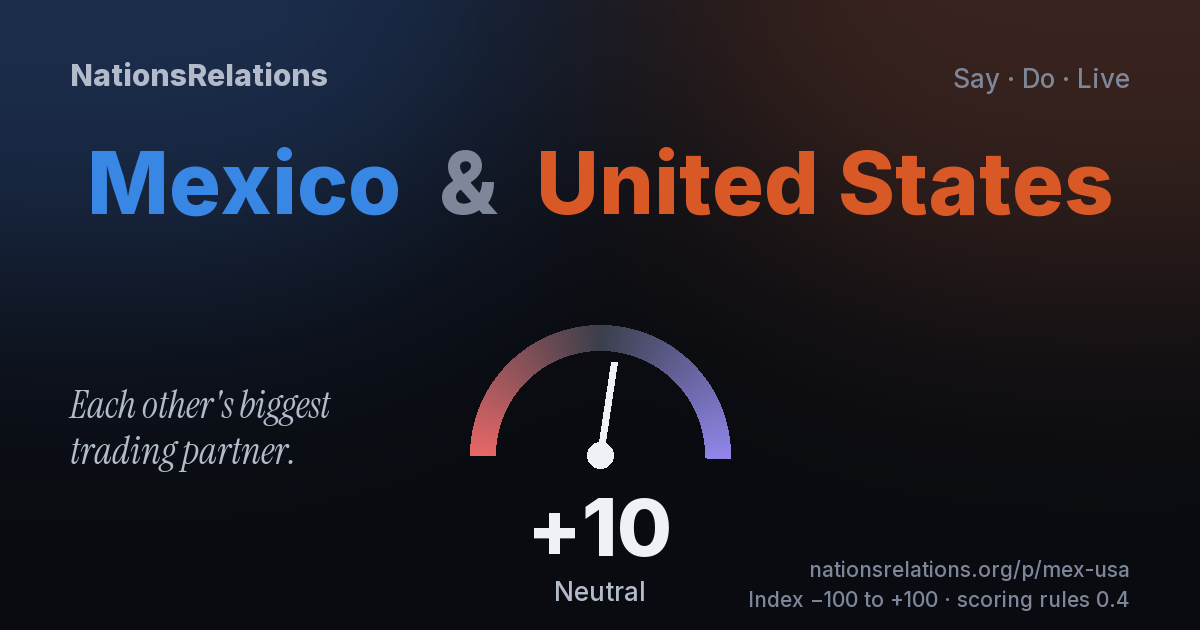
+10

United States

19 sentences about Mexico · since 1946 · United States profile

Each other's biggest trading partner.

Borders are for orientation only and say nothing about disputed territory.

Dashed outlines: areas whose status is disputed. Shapes follow Natural Earth, which draws some areas along recognised borders and others by who administers them on the ground; they say nothing about who is right, and front lines of current wars are not shown.

In short

  • At the UN their vote agreement is 52% (2022–2024), lower than either of them has with most countries.52%vote agreement
  • Trade in goods ($850 billion a year) is very important for Mexico, much less so for the United States.$850 billiona year
  • In its UN General Debate speeches, Mexico names the United States far more often than the reverse (133 sentences against 19).133 · 19sentences
  • 11.3 million people born in Mexico live in the United States (UN DESA counts place of birth, however long ago they moved).11.3 millionpeople
Written by fixed rules from the data below — no AI.

How the index is built

Each score runs from −100 to +100 and counts by its weight. The parts add up to the index.

UN votes 35% -14 score -39 · Vote agreement 52%High confidence
Trade 20% +20 score 100 · $850 billion a yearHigh confidence
Security 30% 0 score 0 · No armed conflict between the two governments recordedHigh confidence
Shared clubs 15% +4 score 25 · 1 shared groupHigh confidence
Words–Not scored until people check the stance labels (0 of 152 checked)
Index+10
What matters to you? Adjust the weights
Explain this scorehow each number is built, step by step

Every score follows fixed rules written out on How it works; no AI is involved. Here are the steps for this pair, with its own numbers. How it works · JSON · Downloads

UN votes −39

  1. Votes are compared with each country's own voting partners, not with all pairs: most of the world votes alike, so a global ranking would make France–Germany +62 and Canada–United States +6.
  2. Among Mexico's 191 voting partners, United States ranks 190 (1 is the closest). That is position 1 on a scale from 0 (the furthest partner) to 100 (the closest).
  3. Among United States's 191 voting partners, Mexico ranks 76: position 61.
  4. The two positions are averaged (31) and stretched to the range −100 to +100: −39.

Inputs: Vote agreement 52% on recorded votes, 2022–2024 (the same vote counts 1, an abstention against a yes or a no ½).

Trade 100

  1. Trade is scored by how much the more dependent side relies on it: the larger of the two shares of total trade, here 71.5%.
  2. On a log scale, 0.1% or less scores 0 and 25% or more scores 100 (a percentile would make 0.1% of a country's trade look like a middling tie).
  3. (log10(71.5%) − log10(0.1%)) ÷ (log10(25%) − log10(0.1%)) × 100 = 119, kept between 0 and 100, so the score is 100.

Inputs: Goods trade both ways: $850 billion a year, 2023–2025 (IMF) · 71.5% of Mexico's trade, 16.5% of United States's.

Security 0

  1. No fighting on opposite sides is recorded in the last 30 years, so security can only push up.
  2. Not both in NATO: +0.
  3. No fighting side by side is recorded: +0.
  4. Sum 0, capped at 80: 0.

Inputs: Opposed: never. Data to 2025. · Not both NATO members.

Shared clubs 25

  1. Each tracked group both belong to adds 25, and so does the same UN regional group. Capped at 100.
  2. 1 shared group (G20) = 1 × 25 = 25.

Inputs: Tracked groups: EU, AU, ARAB, ASEAN, BRICS, G7, G20, GCC, P5.

Index +10

ScoreValueWeightCounts forAdds
UN votes−393535%−13.7
Trade1002020%+20.0
Security03030%+0.0
Shared clubs251515%+3.8

The index is the weighted average of the scores that exist: (35×(−39) + 20×100 + 30×0 + 15×25) ÷ 100 = +10.1, shown as +10. Labels: 55 and up Very close, 25 Close, 0 Neutral, −30 Distant, below Opposed. Weights are yours to change above.

Words (what the two say about each other) are shown but not scored, and the people layer (migration, refugees, football) never is.

How sure are we?how much data stands behind each number

A score is only as good as the data under it. Four levels: High, Medium, Low, None. The thresholds are written on How it works; the level does not change a score, it tells you how far to trust it. How it works

UN votesHigh270 shared votes on whole texts in 2022–2024, the years the headline share covers. With that many, a share is good to about ±6 points.
TradeHighGoods trade is reported in 3 of the 3 years 2023–2025. Goods only, from customs data (IMF); services and energy pipelines are not in it.
SecurityHighThe Uppsala Conflict Data Program covers every state up to 2025. It counts only conflicts with at least 25 battle deaths a year.
Shared clubsHighThe list of tracked groups is fixed; membership is checked by hand.
IndexHighAs sure as the weaker of its two required parts, votes and trade. Security and shared clubs add to it but never make it surer.

Do their voting positions really differ?

In 2025, Mexico stood at −0.14 (90% range −0.30 to +0.01) and United States at +2.89 (+2.76 to +3.03) on the main dimension of UN voting. The gap is 3.03. Their 90% ranges do not overlap: on this dimension the two stand clearly apart.

Positions are the ideal points of Bailey, Strezhnev and Voeten, estimated from every recorded vote; higher means voting more like the United States and Western democracies. They are not a moral score.

Words (what the two say about each other) are counted, not scored, so they carry no level. Moments and the people layer are context and never enter a score.

01 · The story so far

Eighty years, one line

How closely they voted at the UN (vote agreement). Bands are eras found in the data itself; dots are moments; below, who led each country.

Vote agreement on recorded General Assembly votes on whole texts: the same vote counts 1, an abstention against a yes or a no ½, a yes against a no 0. Source: Nations on Record (agreement score of Voeten et al.; UN Digital Library). Leaders: Wikidata, checked by hand.

1946–1978
66%
vote agreement
1979–2024
35%
Further apart than before

Moments

NAFTA, with Canada, enters into force
David Valdez · Public domain
1994NAFTA, with Canada, enters into forcebackground
USMCA replaces NAFTA
Shealah Craighead, The White House · Public domain
2020USMCA replaces NAFTAbackground

Editorial context for this featured pair. Never part of a score.

From the data

1947The first time Mexico named the United States in a UN General Debate speech.
1970The first time the United States named Mexico in a UN General Debate speech.
1980Biggest fall in voting together at the UN: from 56% of votes the same in 1970–1979 to 27% in 1980–1989.
2025Their highest recorded trade in goods, adjusted for inflation: $890 billion both ways in 2025 US dollars ($890 billion in the dollars of the time).
Found in the data by four fixed rules, the same for every pair, not chosen by an editor. Never part of a score. The rules
  • Voting: the year with the biggest difference in vote agreement between the ten years before it and the ten years from it, if that difference is at least 15 points.
  • Armed conflict: every period of consecutive years in which UCDP records the two on opposite sides.
  • Trade: the year with the highest trade in goods both ways, adjusted for inflation with US consumer prices (BLS), if trade is recorded in at least five years.
  • Speeches: for each of the two, the first year it named the other in its UN General Debate speech, counted from the first year both voted at the UN (before that, a name can mean a territory or a state not yet independent).

02 · Say

In their own words

The conversation they never quite had: for each decade, what each government said about the other in its UN General Debate speech.

1940s
Mr. Acheson, the representative of the United States, had told the General Assembly (222nd meeting) that his Government could be depended upon to contribute fully to the creation of the necessary conditions of confidence and, with their attainment, to play its full role in the regulation and reduction, under effective safeguards, of armaments and armed forces. Mr. PADILLA. NERVO · Mexico · 1949
1950s
If this idea was received favourably by other delegations, my delegation would be willing to submit it to the appropriate body, namely the First Committee, in the form of a draft resolution in which that Committee would recommend that the representatives of France, the United Kingdom, the United States and the Union of Soviet Socialist Republics should jointly consider, with the assistance of the Secretary-General, how to resume the negotiations on disarmament. Mr. Padilla Nervo · Mexico · 1958
1960s
America and especially Mexico. Mr. CARRILLO FLORES · Mexico · 1969
1970s
We have been able almost totally to eliminate the economic blockade against a penalized sister nation, and we have made the decision to keep our territories free of nuclear weapons through the Treaty of Tlatelolco10 and the recent Latin-American initiatives to impose restrictions or limitations on the transfer and use of certain conventional weapons. Roel · Mexico · 1978
In this spirit, the United States is willing to examine seriously the proposal by the distinguished President of Mexico for a charter of the economic rights and duties of States." Such a document will make a significant and historic contribution if it reflects the true aspirations of all nations; it will accomplish nothing if it is turned into an indictment of one group of countries by another. Kissinger · United States · 1973
1980s
Paramount importance must be attached to the signing and ratifying of the Soviet-American Treaty on the elimination of their intermediate-range and shorter-range nuclear forces - the INF Treaty. Mr. Amor · Mexico · 1988
At one of the first international assemblies of my presidency, in Cancun, Mexico, I said that history demonstrates that, time and again, in place after place, economic growth and human progress make their greatest strides in countries that encourage economic freedom; that individual farmers, labourers, owners, traders and managers are the heart and soul of development. RONALD REAGAN, President · United States · 1988
1990s
Some prominent ones have been the adoption of the Comprehensive NuclearTest-Ban Treaty, the approval of a Convention prohibiting 22 anti-personnel mines, and the forthcoming conclusion of an inter-American convention against the illicit traffic in arms, munitions and explosives. Angel Gurria, Minister for Foreign Affairs · Mexico · 1997
Next week, I will target more than $100-million worth of defence equipment, services and training to Mexico, Colombia and other South American and Caribbean countries. William Jefferson Clinton, President · United States · 1996
2000s
Included in that population are millions of Mexicans living here in the United States, who have sought opportunities for a dignified life for their families. Felipe Calderon Hinojosa, President · Mexico · 2008
Those names include a man who supported his wife in Mexico, sending home money every week. George W. Bush, President · United States · 2001
2010s
The usurpation of powers, the systematic violation of political rights, the rupture of the democratic order and the humanitarian crisis prevailing in some areas of the American continent are issues that deeply concern us. Mr. Enrique Peña Nieto, President · Mexico · 2018
We have worked closely with our partners in Mexico and Canada to replace the North American Free Trade Agreement with a brand new and, hopefully, bipartisan United States-Mexico-Canada agreement. Mr. Donald Trump, President · United States · 2019
2020s
Empower Mexican communities abroad and call on the US to regularise their status. 2. Alicia Bárcena Ibarra, Minister of Foreign Affairs · Mexico · 2024
We forged historic partnerships with Mexico, Guatemala, Honduras and El Salvador to stop human smuggling. Mr. Donald Trump, President · United States · 2020

Quote rule: for each decade, the first sentence in the latest speech of that decade in which one names the other. Same rule for every pair and both sides.

Who talks about whom

MexicoUnited States

Words next to the name

When Mexico speaks

nuclear22
dialogue10
terrorism3
sanctions2
cooperation2
solidarity2

When the United States speaks

cooperation2
gratitude1
solidarity1

A keyword in the same sentence, not a judgement of who did what.

03 · Do

Votes, trade, war and alliance

Topic by topic

Most alike on disarmament (37% of votes the same), furthest apart on Middle East (15%), against 31% on all votes since 2010.

Colonialism: the vote agreement rose from 0% (2010–14) to 13% (2015–19).

  • All roll-call votes 31% (range 28–33%) since 2010, 1469 votes · 37% all years 2010–14: 22% 2015–19: 20% 2020–25: 20%
  • Disarmament 37% (range 31–45%) since 2010, 179 votes · 38% all years 2010–14: 29% 2015–19: 28%
  • Middle East 15% (range 10–20%) since 2010, 192 votes · 20% all years 2010–14: 0% 2015–19: 1% 2020–25: 0%
  • Human rights 34% (range 28–40%) since 2010, 248 votes · 32% all years 2010–14: 18% 2015–19: 22% 2020–25: 17%
  • Colonialism 24% (range 17–33%) since 2010, 98 votes · 28% all years 2010–14: 0% 2015–19: 13%
  • Nuclear weapons 22% (range 17–29%) since 2010, 200 votes · 30% all years 2010–14: 21% 2015–19: 15% 2020–25: 12%
  • Economic development 27% (range 19–37%) since 2010, 95 votes · 33% all years 2010–14: 22% 2015–19: 24%

Vote agreement on roll-call votes, counted vote by vote the same way as the headline figure: the same vote counts 1, an abstention against a yes or a no ½, a yes against a no 0. Votes on amendments and single paragraphs are left out. Topics are the labels of the UN voting dataset; one resolution can carry several, and about 60% carry none. Disarmament, colonialism and economic development are coded together from 2019, so they count votes up to 2018. Bar: 2010–2025; mark: all years. Shares need at least five shared votes. The thin line on each bar is the 95% sampling range given the number of votes.

Votes that set them apart

Since 2010 they voted on 1469 whole-text resolutions together. On 873 one said yes and the other no; they differed in some way on 1165. The 10 newest, newest first: (the API lists up to 50: API)

Roll-call votes on whole texts at the UN General Assembly, since 2010; amendments and single paragraphs are left out, as in the topic bars. Titles and document symbols: UN Digital Library via Nations on Record; votes: Voeten et al. A vote is not a statement about the other country, only about the text.

Voting positions over time

Each year's position on the main dimension of UN voting, with its 90% range. Where the shaded ranges overlap, the votes of that year cannot tell the two apart. The gap was 1.03 in 1946 and is 3.03 in 2025; it was widest in 1994 (3.75).

-1.5-0.5+0.5+1.5+2.5+3.5 19501960197019801990200020102020

Mexico United States

Show data table
YearMexico90% rangeUnited States90% range
2025-0.14-0.3 – 0.012.892.76 – 3.03
2024-0.02-0.14 – 0.092.161.99 – 2.35
20230.02-0.1 – 0.142.292.1 – 2.47
2022-0.01-0.14 – 0.122.242.06 – 2.44
2021-0.05-0.18 – 0.082.412.24 – 2.59
2020-0.02-0.16 – 0.122.422.25 – 2.57
2019-0.01-0.13 – 0.112.442.29 – 2.61
2018-0.01-0.14 – 0.122.552.39 – 2.72
20170.02-0.12 – 0.152.52.32 – 2.68
2016-0.13-0.3 – 0.022.42.19 – 2.6
2015-0.18-0.34 – -0.022.442.24 – 2.64
2014-0.09-0.27 – 0.062.472.27 – 2.66
2013-0.17-0.36 – 0.02.492.29 – 2.7
2012-0.01-0.16 – 0.132.422.24 – 2.59
2011-0.1-0.27 – 0.062.432.24 – 2.61
2010-0.04-0.2 – 0.122.42.22 – 2.58
2009-0.11-0.26 – 0.042.422.23 – 2.61
2008-0.15-0.32 – 0.012.632.45 – 2.8
2007-0.12-0.28 – 0.042.72.52 – 2.87
2006-0.1-0.25 – 0.052.722.55 – 2.88
2005-0.08-0.24 – 0.082.762.58 – 2.94
2004-0.14-0.31 – 0.032.722.53 – 2.9
2003-0.27-0.48 – -0.072.792.61 – 2.96
2002-0.31-0.54 – -0.112.672.51 – 2.85
2001-0.55-0.81 – -0.282.592.42 – 2.77
2000-0.44-0.72 – -0.182.62.42 – 2.78
1999-0.44-0.69 – -0.212.632.45 – 2.82
1998-0.62-0.95 – -0.312.822.62 – 3.03
1997-0.36-0.61 – -0.123.052.82 – 3.28
1996-0.34-0.61 – -0.083.042.78 – 3.28
1995-0.46-0.76 – -0.193.082.81 – 3.35
1994-0.67-1.01 – -0.333.092.83 – 3.35
1993-0.33-0.61 – -0.062.952.72 – 3.17
1992-0.37-0.64 – -0.132.92.72 – 3.09
1991-0.76-1.13 – -0.42.862.68 – 3.05
1990-0.75-1.18 – -0.362.972.79 – 3.15
1989-0.33-0.62 – -0.073.052.89 – 3.21
1988-0.48-0.77 – -0.22.952.81 – 3.09
1987-0.5-0.76 – -0.252.922.78 – 3.07
1986-0.33-0.53 – -0.142.842.7 – 2.98
1985-0.41-0.6 – -0.232.722.6 – 2.85
1984-0.64-0.85 – -0.452.72.57 – 2.84
1983-0.34-0.54 – -0.152.542.41 – 2.67
1982-0.34-0.53 – -0.172.512.37 – 2.65
1981-0.31-0.51 – -0.12.642.48 – 2.8
1980-0.14-0.34 – 0.052.372.2 – 2.55
19790.08-0.1 – 0.252.352.18 – 2.53
19780.410.24 – 0.592.22.01 – 2.41
19770.310.09 – 0.532.282.08 – 2.49
19760.09-0.18 – 0.352.762.55 – 3.01
19750.05-0.21 – 0.32.472.22 – 2.72
19740.40.17 – 0.632.071.84 – 2.32
19730.19-0.16 – 0.492.282.07 – 2.52
19720.13-0.22 – 0.452.282.05 – 2.52
19710.11-0.28 – 0.492.01.8 – 2.21
19700.510.2 – 0.812.482.2 – 2.77
19690.570.17 – 0.932.321.99 – 2.67
19680.70.36 – 1.032.321.94 – 2.69
19670.70.3 – 1.062.582.16 – 3.0
19660.910.57 – 1.252.422.05 – 2.82
19650.840.52 – 1.152.331.91 – 2.71
19630.550.11 – 0.951.991.61 – 2.39
19620.820.49 – 1.142.011.65 – 2.4
19610.650.36 – 0.931.531.18 – 1.88
19600.670.32 – 1.032.051.62 – 2.48
19590.15-0.26 – 0.571.51.11 – 1.88
19580.23-0.13 – 0.611.280.82 – 1.74
19570.21-0.09 – 0.481.290.96 – 1.66
19560.70.18 – 1.241.10.54 – 1.66
19550.28-0.47 – 1.061.991.09 – 2.89
1954-0.03-0.71 – 0.681.510.88 – 2.15
1953-0.22-0.72 – 0.311.461.03 – 1.92
1952-0.21-0.56 – 0.182.011.55 – 2.49
19510.35-0.28 – 1.021.30.62 – 2.0
19500.15-0.47 – 0.771.250.75 – 1.76
19490.620.11 – 1.131.671.13 – 2.22
19480.15-0.36 – 0.671.720.91 – 2.55
19470.29-0.18 – 0.711.611.02 – 2.24
19460.610.09 – 1.141.630.93 – 2.38

Positions are the ideal points of Bailey, Strezhnev and Voeten, estimated from every recorded vote; higher means voting more like the United States and Western democracies. They are not a moral score. Source: Nations on Record (Bailey, Strezhnev and Voeten).

On the UN voting map

In 2020–24, Mexico voted with Brazil, Myanmar and 32 others (35 countries in all) and United States with Japan, Türkiye and 38 others (41). They were never in the same bloc in the 8 periods since 1946.

Loading the map…

Drag the year to see how the blocs changed since 1946.

Each dot is a country, placed by how alike it voted that year: close dots voted alike. Colours are voting blocs, groups of countries among each other's closest voting partners in that period. The axes have no units; the United States is kept on the right and China at the top. Click a dot to open that country's pair with Mexico. Source: Nations on Record, which shows the blocs in full. Inside the blocs (Nations on Record). Never part of a score.

Friends in common

The countries each one votes most alike with at the UN. Countries in the middle vote alike with both.

Trade over time

Mexico sells to the United StatesUnited States sells to Mexico

Goods exports, current US dollars. IMF via Nations on Record.

Who needs whom

Arrow width: yearly goods flow in each direction (2023–2025). Bars: share of each country's total trade.

Security

No armed conflict between the two governments, and no fighting side by side, is recorded since 1946.

Counted: the two governments on opposite sides, or one sending troops to fight against the other. Fighting with armed groups based in the other country is not counted. UCDP Dyadic Dataset 26.1, data to 2025.

Shared clubs

G20

EU, African Union, Arab League, ASEAN, BRICS, G7, G20, GCC, the P5 and UN regional groups. NATO counts under Security.

Trade agreements

They share one trade agreement notified to the WTO: United States-Mexico-Canada Agreement (USMCA/CUSMA/T-MEC).

Agreements notified to the WTO, in force or signed. When a bloc such as the EU signs as one party, the agreement links its members with the other side, not with each other. The status is as notified to the WTO; whether an agreement is still applied between these two countries is not checked. Source: WTO Regional Trade Agreements database.

Sanctions

Neither applies a UN, EU, US or UK sanctions regime to the other.

Country regimes of the UN Security Council, the EU, the United States and the United Kingdom; thematic lists (terrorism, cyber, human rights) are left out, and so are other countries' own lists. A regime can target a government, officials or companies; it is not a measure of the relationship. Sources: EU Sanctions Map, OFAC (US Treasury), UK government. Never part of a score.

04 · Live

Between people

Governments argue; people move, study, flee and play football. None of this enters the index.

Living in the other country

born in Mexicoborn in the United States

International migrant stock, UN DESA 2024. By place of birth: this includes refugees, and people born before today's borders, for example in a state that later split.

Refugees & asylum seekers
224,000
from Mexico in the United States (2025)
155
from the United States in Mexico (2025)

UNHCR. Refugees and asylum seekers only: people given citizenship on arrival are not counted.

Ask about Mexico & United StatesLocal AI · answers only from this page's data · numbers checked

The answers are written by an AI language model, not by the site's editors. It can be wrong; the numbers and sources on this page are the reference.

What changed recently

  • Voting together: up 15 points (2019–2021: 37%, 2022–2024: 52%).
  • Trade: up 26% ($675 billion → $850 billion a year).
  • Sentences naming each other at the UN: 7 in the last five General Debates, 12 in the five before.

Sources & coverage

  • Speeches, mentions, votes, trade: Nations on Record, loaded 2026-10-12 20:33 UTC.
  • UCDP Dyadic and Battle-Related Deaths datasets, version 26.1, loaded 2026-11-14 20:06 UTC.
  • UN DESA International Migrant Stock 2024, loaded 2026-10-12 20:18 UTC. UNHCR Refugee Population Statistics (api.unhcr.org), 2000–2025, loaded 2026-10-12 20:18 UTC.
  • International football results 1872–present (Mart Jürisoo, CC0), loaded 2026-10-12 20:18 UTC.
  • Scoring rules 0.4 (14 Nov 2026), scores built 2026-11-14 21:20 UTC. Every rule.