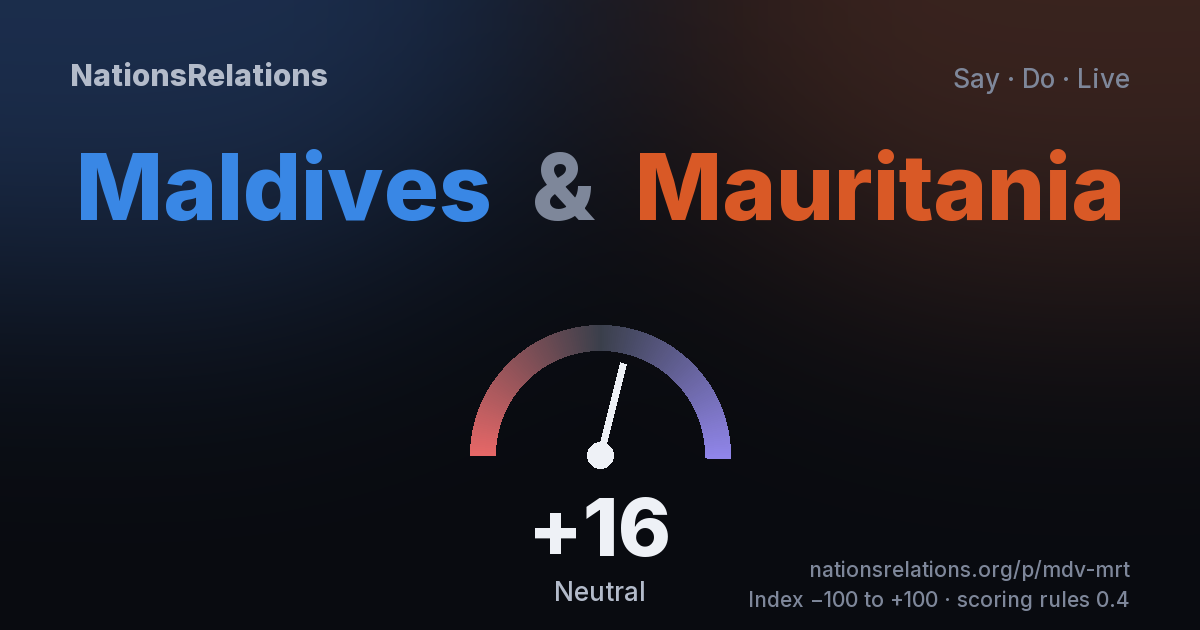
A score is only as good as the data under it. Four levels: High, Medium, Low, None. The thresholds are written on How it works; the level does not change a score, it tells you how far to trust it. How it works
UN votesHigh249 shared votes on whole texts in 2022–2024, the years the headline share covers. With that many, a share is good to about ±6 points.
TradeLowNo goods trade is reported for 2023–2025, so the score is 0. The data cannot tell zero trade from trade that was not reported.
SecurityHighThe Uppsala Conflict Data Program covers every state up to 2025. It counts only conflicts with at least 25 battle deaths a year.
Shared clubsHighThe list of tracked groups is fixed; membership is checked by hand.
IndexLowAs sure as the weaker of its two required parts, votes and trade. Security and shared clubs add to it but never make it surer.
Do their voting positions really differ?
In 2025, Maldives stood at −0.50 (90% range −0.76 to −0.26) and Mauritania at −0.69 (−0.98 to −0.42) on the main dimension of UN voting. The gap is 0.19. Their 90% ranges overlap: from their votes alone we cannot tell the two positions apart.
Positions are the ideal points of Bailey, Strezhnev and Voeten, estimated from every recorded vote; higher means voting more like the United States and Western democracies. They are not a moral score.
Words (what the two say about each other) are counted, not scored, so they carry no level. Moments and the people layer are context and never enter a score.