Poland

20 sentences about South Korea · since 1946 · Poland profile
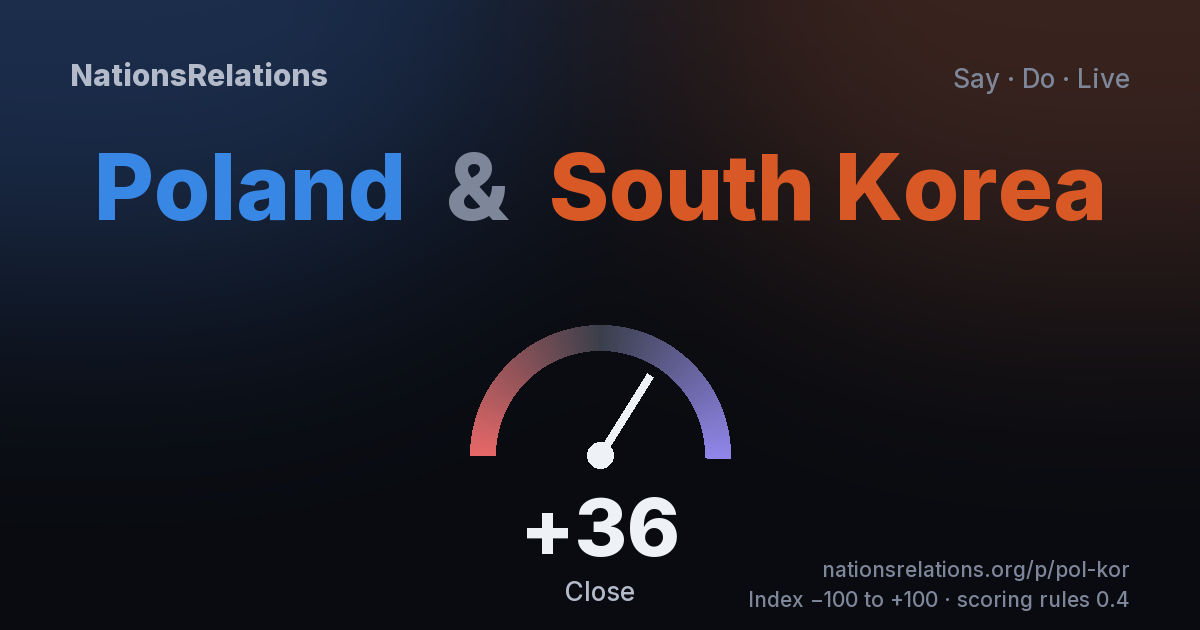
+36

South Korea

1 sentence about Poland · since 1946 · South Korea profile
Borders are for orientation only and say nothing about disputed territory.

Dashed outlines: areas whose status is disputed. Shapes follow Natural Earth, which draws some areas along recognised borders and others by who administers them on the ground; they say nothing about who is right, and front lines of current wars are not shown.

In short

  • At the UN their vote agreement is 95% (2022–2024), among the highest either of them has with any country.95%vote agreement
  • Trade in goods ($9.9 billion a year) is modest for Poland, and about as important for South Korea.$9.9 billiona year
  • In its UN General Debate speeches, Poland names South Korea far more often than the reverse (20 sentences against 1).20 · 1sentences
Written by fixed rules from the data below — no AI.

How the index is built

Each score runs from −100 to +100 and counts by its weight. The parts add up to the index.

UN votes 35% +27 score +76 · Vote agreement 95%High confidence
Trade 20% +9 score 45 · $9.9 billion a yearHigh confidence
Security 30% 0 score 0 · No armed conflict between the two governments recordedHigh confidence
Shared clubs 15% 0 score 0 · 0 shared groupsHigh confidence
Words–Not scored until people check the stance labels (0 of 21 checked)
Index+36
What matters to you? Adjust the weights
Explain this scorehow each number is built, step by step

Every score follows fixed rules written out on How it works; no AI is involved. Here are the steps for this pair, with its own numbers. How it works · JSON · Downloads

UN votes +76

  1. Votes are compared with each country's own voting partners, not with all pairs: most of the world votes alike, so a global ranking would make France–Germany +62 and Canada–United States +6.
  2. Among Poland's 191 voting partners, South Korea ranks 26 (1 is the closest). That is position 87 on a scale from 0 (the furthest partner) to 100 (the closest).
  3. Among South Korea's 191 voting partners, Poland ranks 22: position 89.
  4. The two positions are averaged (88) and stretched to the range −100 to +100: +76.

Inputs: Vote agreement 95% on recorded votes, 2022–2024 (the same vote counts 1, an abstention against a yes or a no ½).

Trade 45

  1. Trade is scored by how much the more dependent side relies on it: the larger of the two shares of total trade, here 1.23%.
  2. On a log scale, 0.1% or less scores 0 and 25% or more scores 100 (a percentile would make 0.1% of a country's trade look like a middling tie).
  3. (log10(1.23%) − log10(0.1%)) ÷ (log10(25%) − log10(0.1%)) × 100 = 45, kept between 0 and 100, so the score is 45.

Inputs: Goods trade both ways: $9.9 billion a year, 2023–2025 (IMF) · 1.23% of Poland's trade, 0.853% of South Korea's.

Security 0

  1. No fighting on opposite sides is recorded in the last 30 years, so security can only push up.
  2. Not both in NATO: +0.
  3. No fighting side by side is recorded: +0.
  4. Sum 0, capped at 80: 0.

Inputs: Opposed: never. Data to 2025. · Not both NATO members.

Shared clubs 0

  1. Each tracked group both belong to adds 25, and so does the same UN regional group. Capped at 100.
  2. 0 shared groups = 0 × 25 = 0.

Inputs: Tracked groups: EU, AU, ARAB, ASEAN, BRICS, G7, G20, GCC, P5.

Index +36

ScoreValueWeightCounts forAdds
UN votes763535%+26.6
Trade452020%+9.0
Security03030%+0.0
Shared clubs01515%+0.0

The index is the weighted average of the scores that exist: (35×76 + 20×45 + 30×0 + 15×0) ÷ 100 = +35.6, shown as +36. Labels: 55 and up Very close, 25 Close, 0 Neutral, −30 Distant, below Opposed. Weights are yours to change above.

Words (what the two say about each other) are shown but not scored, and the people layer (migration, refugees, football) never is.

How sure are we?how much data stands behind each number

A score is only as good as the data under it. Four levels: High, Medium, Low, None. The thresholds are written on How it works; the level does not change a score, it tells you how far to trust it. How it works

UN votesHigh271 shared votes on whole texts in 2022–2024, the years the headline share covers. With that many, a share is good to about ±6 points.
TradeHighGoods trade is reported in 3 of the 3 years 2023–2025. Goods only, from customs data (IMF); services and energy pipelines are not in it.
SecurityHighThe Uppsala Conflict Data Program covers every state up to 2025. It counts only conflicts with at least 25 battle deaths a year.
Shared clubsHighThe list of tracked groups is fixed; membership is checked by hand.
IndexHighAs sure as the weaker of its two required parts, votes and trade. Security and shared clubs add to it but never make it surer.

Do their voting positions really differ?

In 2025, Poland stood at +1.06 (90% range +0.94 to +1.20) and South Korea at +0.84 (+0.71 to +0.97) on the main dimension of UN voting. The gap is 0.22. Their 90% ranges overlap: from their votes alone we cannot tell the two positions apart.

Positions are the ideal points of Bailey, Strezhnev and Voeten, estimated from every recorded vote; higher means voting more like the United States and Western democracies. They are not a moral score.

Words (what the two say about each other) are counted, not scored, so they carry no level. Moments and the people layer are context and never enter a score.

01 · The story so far

Eighty years, one line

How closely they voted at the UN (vote agreement). Bands are eras found in the data itself; dots are moments; below, who led each country.

Vote agreement on recorded General Assembly votes on whole texts: the same vote counts 1, an abstention against a yes or a no ½, a yes against a no 0. Source: Nations on Record (agreement score of Voeten et al.; UN Digital Library). Leaders: Wikidata, checked by hand.

1991–1998
86%
vote agreement
1999–2024
93%
Closer than before

From the data

1991The first year both named each other in their UN General Debate speeches.
2023Their highest recorded trade in goods, adjusted for inflation: $11 billion both ways in 2025 US dollars ($10.0 billion in the dollars of the time).
Found in the data by four fixed rules, the same for every pair, not chosen by an editor. Never part of a score. The rules
  • Voting: the year with the biggest difference in vote agreement between the ten years before it and the ten years from it, if that difference is at least 15 points.
  • Armed conflict: every period of consecutive years in which UCDP records the two on opposite sides.
  • Trade: the year with the highest trade in goods both ways, adjusted for inflation with US consumer prices (BLS), if trade is recorded in at least five years.
  • Speeches: for each of the two, the first year it named the other in its UN General Debate speech, counted from the first year both voted at the UN (before that, a name can mean a territory or a state not yet independent).

02 · Say

In their own words

The conversation they never quite had: for each decade, what each government said about the other in its UN General Debate speech.

1950s
Often under difficult conditions, particularly in South Korea, where the authorities are instigating acts hostile to peace tending to render the Commission's work impossible, the Polish representatives spare no effort to carry out their duty. Mr. Naszkowski · Poland · 1955
1960s
The time has come to dissolve the United Nations Commission for the Unification and Rehabilitation of Korea and to withdraw United States troops from South Korea. Mr. JEDRYCHOWSKI · Poland · 1969
1970s
There is no doubt that a peaceful and just settlement of the situation in Korea could have been achieved if the basic conditions had been met to enable the Korean people to exercise their right to self-determination: the withdrawal of all foreign troops from South Korea and the dissolution of the so-called United Nations Commission for the Unification and Rehabilitation of Korea. Mr. JEDRYCHOWSKI · Poland · 1971
1980s
Poland has stressed on many occasions, however, that there cannot be a more secure world without the peaceful resolution of regional conflict situations: in the Middle East, on the basis of the return of the occupied territories and respect for the right of all peoples to self-determination·, in southern Africa, through the elimination of apartheid and the exercise of the right of the people of Namibia to self-determination; around Afghanistan and Kampuchea, with the implementation of the policy of national reconciliation and dialogue with the States concerned; in Central America, with respect for the original initiative of the States of the region; in Europe, with a settlement of the Cyprus problem; and in the Korean peninsula, with the peaceful reunification of the Korean people in accordance with the proposals of the People's Democratic Republic of Korea. Mr, ORZECHOWSKI · Poland · 1987
1990s
It is with special gratification that I welcome in our midst seven new Members of the Organisation! the Democratic People's Republic of Korea, the Republic of Korea, the Federated States of Micronesia, the Republic of the Marshall Islands, and the Baltic Republics - Estonia, Latvia and Lithuania. SKUBISZEWSKI · Poland · 1991
From the workers of the Solidarity Movement in Gdansk, who raised the banner of reform in Poland, to the courageous Government in Budapest; from those freedom-inspired crowds who filled Prague's Vaclavske Plaza, to those former East Germans who tore down the Berlin Wall: they not only freed themselves, but opened the road towards genuine world peace. ROH TAE WOO, President · South Korea · 1991
2000s
That was the purpose of the Government of Poland when it decided, together with the Governments of Chile, India, the Republic of Korea, Mali, the United States and the Czech Republic, to initiate broader international collaboration in the cause of consolidation and promotion of democracy in the world. Wladyslaw Bartoszewski, Minister for Foreign Affairs · Poland · 2000

Quote rule: for each decade, the first sentence in the latest speech of that decade in which one names the other. Same rule for every pair and both sides.

Who talks about whom

PolandSouth Korea

Words next to the name

When Poland speaks

occupation4
dialogue2
gratitude1
terrorism1

When South Korea speaks

solidarity1

A keyword in the same sentence, not a judgement of who did what.

03 · Do

Votes, trade, war and alliance

Topic by topic

Overall agreement hides what separates two governments. Here it is counted per issue.

Nuclear weapons: the vote agreement rose from 55% (2010–14) to 79% (2020–25).

  • All roll-call votes 93% (range 91–94%) since 2010, 1447 votes · 91% all years 2010–14: 84% 2015–19: 86% 2020–25: 88%
  • Disarmament 85% (range 79–90%) since 2010, 177 votes · 85% all years 2010–14: 65% 2015–19: 76%
  • Middle East 99% (range 97–100%) since 2010, 184 votes · 96% all years 2010–14: 100% 2015–19: 99% 2020–25: 98%
  • Human rights 96% (range 93–98%) since 2010, 246 votes · 92% all years 2010–14: 92% 2015–19: 94% 2020–25: 89%
  • Colonialism 97% (range 92–99%) since 2010, 97 votes · 91% all years 2010–14: 98% 2015–19: 90%
  • Nuclear weapons 85% (range 79–89%) since 2010, 198 votes · 82% all years 2010–14: 55% 2015–19: 75% 2020–25: 79%
  • Economic development 93% (range 86–97%) since 2010, 94 votes · 90% all years 2010–14: 83% 2015–19: 91%

Vote agreement on roll-call votes, counted vote by vote the same way as the headline figure: the same vote counts 1, an abstention against a yes or a no ½, a yes against a no 0. Votes on amendments and single paragraphs are left out. Topics are the labels of the UN voting dataset; one resolution can carry several, and about 60% carry none. Disarmament, colonialism and economic development are coded together from 2019, so they count votes up to 2018. Bar: 2010–2025; mark: all years. Shares need at least five shared votes. The thin line on each bar is the 95% sampling range given the number of votes.

Votes that set them apart

Since 2010 they voted on 1447 whole-text resolutions together. On 4 one said yes and the other no; they differed in some way on 201. All of them, newest first: (the API lists up to 50: API)

Roll-call votes on whole texts at the UN General Assembly, since 2010; amendments and single paragraphs are left out, as in the topic bars. Titles and document symbols: UN Digital Library via Nations on Record; votes: Voeten et al. A vote is not a statement about the other country, only about the text.

Voting positions over time

Each year's position on the main dimension of UN voting, with its 90% range. Where the shaded ranges overlap, the votes of that year cannot tell the two apart. The gap was 0.86 in 1991 and is 0.22 in 2025; it was widest in 1995 (0.98).

0+0.5+1.0+1.5+2.0 200020102020

Poland South Korea

Show data table
YearPoland90% rangeSouth Korea90% range
20251.060.94 – 1.20.840.71 – 0.97
20241.170.99 – 1.340.940.8 – 1.09
20231.130.95 – 1.310.890.73 – 1.04
20221.120.95 – 1.320.860.7 – 1.01
20211.080.91 – 1.240.830.68 – 0.97
20201.130.97 – 1.310.740.62 – 0.88
20191.10.95 – 1.250.70.58 – 0.82
20181.110.95 – 1.290.80.66 – 0.94
20171.020.85 – 1.210.890.74 – 1.06
20161.030.85 – 1.220.940.77 – 1.12
20151.060.88 – 1.240.750.61 – 0.9
20140.960.79 – 1.140.720.58 – 0.88
20130.940.76 – 1.150.650.48 – 0.81
20120.970.77 – 1.180.670.52 – 0.83
20110.970.76 – 1.20.630.47 – 0.79
20101.050.87 – 1.240.610.47 – 0.77
20091.070.89 – 1.260.610.47 – 0.75
20080.990.8 – 1.180.630.48 – 0.78
20070.960.77 – 1.160.570.43 – 0.72
20060.960.77 – 1.160.670.51 – 0.82
20050.990.81 – 1.190.520.38 – 0.66
20041.050.86 – 1.260.710.56 – 0.86
20031.170.98 – 1.360.720.57 – 0.87
20021.050.86 – 1.250.780.61 – 0.94
20011.110.9 – 1.320.610.46 – 0.77
20001.150.92 – 1.390.60.43 – 0.76
19991.10.88 – 1.330.560.41 – 0.73
19981.170.95 – 1.390.660.48 – 0.84
19971.341.1 – 1.570.610.44 – 0.79
19961.381.15 – 1.640.610.44 – 0.77
19951.511.22 – 1.780.530.33 – 0.73
19941.461.22 – 1.70.560.37 – 0.75
19931.371.15 – 1.60.560.4 – 0.72
19921.331.15 – 1.510.550.38 – 0.7
19911.361.19 – 1.530.50.35 – 0.64

Positions are the ideal points of Bailey, Strezhnev and Voeten, estimated from every recorded vote; higher means voting more like the United States and Western democracies. They are not a moral score. Source: Nations on Record (Bailey, Strezhnev and Voeten).

On the UN voting map

In 2020–24 both voted in the same bloc, with United States, Japan and 37 others (41 countries in all). They shared a bloc in 3 of the 4 periods since 1946.

Loading the map…

Drag the year to see how the blocs changed since 1946.

Each dot is a country, placed by how alike it voted that year: close dots voted alike. Colours are voting blocs, groups of countries among each other's closest voting partners in that period. The axes have no units; the United States is kept on the right and China at the top. Click a dot to open that country's pair with Poland. Source: Nations on Record, which shows the blocs in full. Inside the blocs (Nations on Record). Never part of a score.

Friends in common

The countries each one votes most alike with at the UN. Countries in the middle vote alike with both.

Trade over time

Poland sells to South KoreaSouth Korea sells to Poland

Goods exports, current US dollars. IMF via Nations on Record.

Who needs whom

Arrow width: yearly goods flow in each direction (2023–2025). Bars: share of each country's total trade.

Security

No armed conflict between the two governments, and no fighting side by side, is recorded since 1946.

Counted: the two governments on opposite sides, or one sending troops to fight against the other. Fighting with armed groups based in the other country is not counted. UCDP Dyadic Dataset 26.1, data to 2025.

Shared clubs

They share none of the groups we track.

EU, African Union, Arab League, ASEAN, BRICS, G7, G20, GCC, the P5 and UN regional groups. NATO counts under Security.

Trade agreements

They share one trade agreement notified to the WTO: EU - Korea, Republic of.

Agreements notified to the WTO, in force or signed. When a bloc such as the EU signs as one party, the agreement links its members with the other side, not with each other. The status is as notified to the WTO; whether an agreement is still applied between these two countries is not checked. Source: WTO Regional Trade Agreements database.

Sanctions

Neither applies a UN, EU, US or UK sanctions regime to the other.

Country regimes of the UN Security Council, the EU, the United States and the United Kingdom; thematic lists (terrorism, cyber, human rights) are left out, and so are other countries' own lists. A regime can target a government, officials or companies; it is not a measure of the relationship. Sources: EU Sanctions Map, OFAC (US Treasury), UK government. Never part of a score.

04 · Live

Between people

Governments argue; people move, study, flee and play football. None of this enters the index.

Living in the other country

International migrant stock, UN DESA 2024. By place of birth: this includes refugees, and people born before today's borders, for example in a state that later split.

Refugees & asylum seekers
0
from Poland in South Korea
5
from South Korea in Poland (2024)

UNHCR. Refugees and asylum seekers only: people given citizenship on arrival are not counted.

Ask about Poland & South KoreaLocal AI · answers only from this page's data · numbers checked

The answers are written by an AI language model, not by the site's editors. It can be wrong; the numbers and sources on this page are the reference.

What changed recently

  • Voting together: about the same (95% in 2022–2024).
  • Trade: up 32% ($7.5 billion → $9.9 billion a year).

Sources & coverage

  • Speeches, mentions, votes, trade: Nations on Record, loaded 2026-10-12 20:33 UTC.
  • UCDP Dyadic and Battle-Related Deaths datasets, version 26.1, loaded 2026-11-14 20:06 UTC.
  • UN DESA International Migrant Stock 2024, loaded 2026-10-12 20:18 UTC. UNHCR Refugee Population Statistics (api.unhcr.org), 2000–2025, loaded 2026-10-12 20:18 UTC.
  • International football results 1872–present (Mart Jürisoo, CC0), loaded 2026-10-12 20:18 UTC.
  • Scoring rules 0.4 (14 Nov 2026), scores built 2026-11-14 21:20 UTC. Every rule.