Albania

1006 sentences about the United States · since 1946 · Albania profile
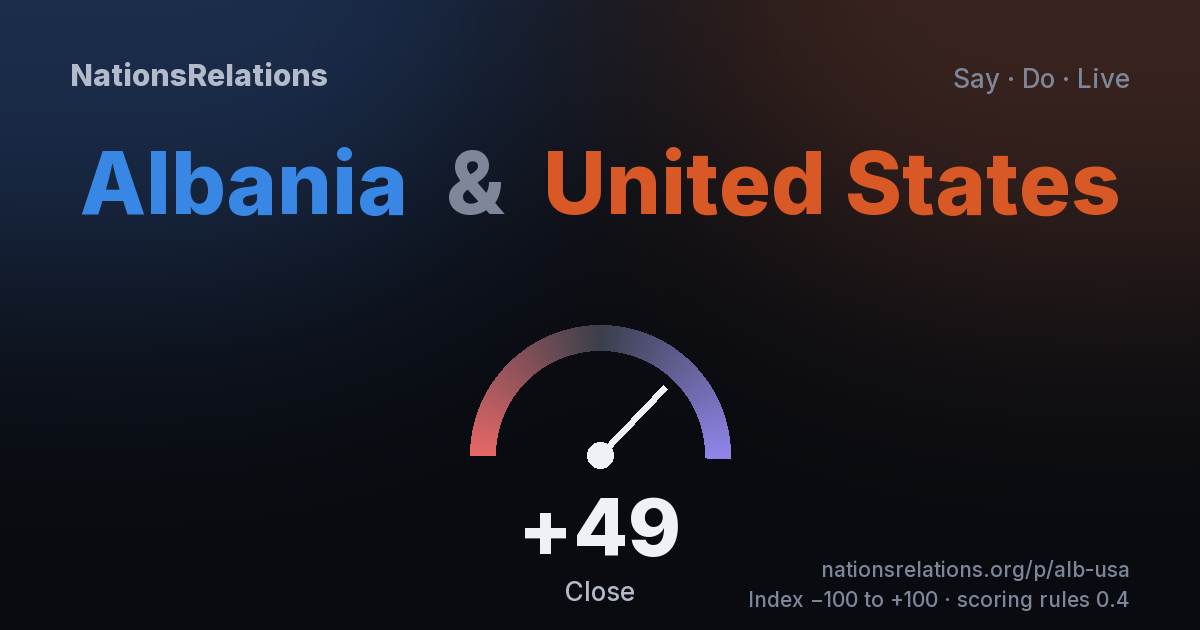
+49

United States

5 sentences about Albania · since 1946 · United States profile
Borders are for orientation only and say nothing about disputed territory.

Dashed outlines: areas whose status is disputed. Shapes follow Natural Earth, which draws some areas along recognised borders and others by who administers them on the ground; they say nothing about who is right, and front lines of current wars are not shown.

In short

  • They are military allies in NATO, and no armed conflict between them is recorded.NATO allies
  • At the UN their vote agreement is 80% (2022–2024), among the highest either of them has with any country.80%vote agreement
  • Trade in goods ($220 million a year) is modest for Albania, much less so for the United States.$220 milliona year
  • In its UN General Debate speeches, Albania names the United States far more often than the reverse (1,006 sentences against 5).1006 · 5sentences
  • 2,100 people born in the United States live in Albania (UN DESA counts place of birth, however long ago they moved).2,100people
Written by fixed rules from the data below — no AI.

How the index is built

Each score runs from −100 to +100 and counts by its weight. The parts add up to the index.

UN votes 35% +24 score +68 · Vote agreement 80%High confidence
Trade 20% +10 score 51 · $220 million a yearHigh confidence
Security 30% +15 score +50 · NATO alliesHigh confidence
Shared clubs 15% 0 score 0 · 0 shared groupsHigh confidence
Words–Not scored until people check the stance labels (0 of 1011 checked)
Index+49
What matters to you? Adjust the weights
Explain this scorehow each number is built, step by step

Every score follows fixed rules written out on How it works; no AI is involved. Here are the steps for this pair, with its own numbers. How it works · JSON · Downloads

UN votes +68

  1. Votes are compared with each country's own voting partners, not with all pairs: most of the world votes alike, so a global ranking would make France–Germany +62 and Canada–United States +6.
  2. Among Albania's 191 voting partners, United States ranks 53 (1 is the closest). That is position 73 on a scale from 0 (the furthest partner) to 100 (the closest).
  3. Among United States's 191 voting partners, Albania ranks 10: position 95.
  4. The two positions are averaged (84) and stretched to the range −100 to +100: +68.

Inputs: Vote agreement 80% on recorded votes, 2022–2024 (the same vote counts 1, an abstention against a yes or a no ½).

Trade 51

  1. Trade is scored by how much the more dependent side relies on it: the larger of the two shares of total trade, here 1.68%.
  2. On a log scale, 0.1% or less scores 0 and 25% or more scores 100 (a percentile would make 0.1% of a country's trade look like a middling tie).
  3. (log10(1.68%) − log10(0.1%)) ÷ (log10(25%) − log10(0.1%)) × 100 = 51, kept between 0 and 100, so the score is 51.

Inputs: Goods trade both ways: $220 million a year, 2023–2025 (IMF) · 1.68% of Albania's trade, 0.00428% of United States's.

Security +50

  1. No fighting on opposite sides is recorded in the last 30 years, so security can only push up.
  2. Both in NATO: +50.
  3. No fighting side by side is recorded: +0.
  4. Sum 50, capped at 80: 50.

Inputs: Opposed: never. Data to 2025. · Both are NATO members.

Shared clubs 0

  1. Each tracked group both belong to adds 25, and so does the same UN regional group. Capped at 100.
  2. 0 shared groups = 0 × 25 = 0.

Inputs: Tracked groups: EU, AU, ARAB, ASEAN, BRICS, G7, G20, GCC, P5.

Index +49

ScoreValueWeightCounts forAdds
UN votes683535%+23.8
Trade512020%+10.2
Security503030%+15.0
Shared clubs01515%+0.0

The index is the weighted average of the scores that exist: (35×68 + 20×51 + 30×50 + 15×0) ÷ 100 = +49.0, shown as +49. Labels: 55 and up Very close, 25 Close, 0 Neutral, −30 Distant, below Opposed. Weights are yours to change above.

Words (what the two say about each other) are shown but not scored, and the people layer (migration, refugees, football) never is.

How sure are we?how much data stands behind each number

A score is only as good as the data under it. Four levels: High, Medium, Low, None. The thresholds are written on How it works; the level does not change a score, it tells you how far to trust it. How it works

UN votesHigh271 shared votes on whole texts in 2022–2024, the years the headline share covers. With that many, a share is good to about ±6 points.
TradeHighGoods trade is reported in 3 of the 3 years 2023–2025. Goods only, from customs data (IMF); services and energy pipelines are not in it.
SecurityHighThe Uppsala Conflict Data Program covers every state up to 2025. It counts only conflicts with at least 25 battle deaths a year.
Shared clubsHighThe list of tracked groups is fixed; membership is checked by hand.
IndexHighAs sure as the weaker of its two required parts, votes and trade. Security and shared clubs add to it but never make it surer.

Do their voting positions really differ?

In 2025, Albania stood at +0.99 (90% range +0.87 to +1.12) and United States at +2.89 (+2.76 to +3.03) on the main dimension of UN voting. The gap is 1.90. Their 90% ranges do not overlap: on this dimension the two stand clearly apart.

Positions are the ideal points of Bailey, Strezhnev and Voeten, estimated from every recorded vote; higher means voting more like the United States and Western democracies. They are not a moral score.

Words (what the two say about each other) are counted, not scored, so they carry no level. Moments and the people layer are context and never enter a score.

01 · The story so far

Eighty years, one line

How closely they voted at the UN (vote agreement). Bands are eras found in the data itself; dots are moments; below, who led each country.

Vote agreement on recorded General Assembly votes on whole texts: the same vote counts 1, an abstention against a yes or a no ½, a yes against a no 0. Source: Nations on Record (agreement score of Voeten et al.; UN Digital Library). Leaders: Wikidata, checked by hand.

1956–1990
26%
vote agreement
1991–2024
62%
Closer than before

From the data

1957The first time Albania named the United States in a UN General Debate speech.
1991Biggest rise in voting together at the UN: from 17% of votes the same in 1981–1990 to 63% in 1991–2000.
1998The first time the United States named Albania in a UN General Debate speech.
2022Their highest recorded trade in goods, adjusted for inflation: $259 million both ways in 2025 US dollars ($235 million in the dollars of the time).
Found in the data by four fixed rules, the same for every pair, not chosen by an editor. Never part of a score. The rules
  • Voting: the year with the biggest difference in vote agreement between the ten years before it and the ten years from it, if that difference is at least 15 points.
  • Armed conflict: every period of consecutive years in which UCDP records the two on opposite sides.
  • Trade: the year with the highest trade in goods both ways, adjusted for inflation with US consumer prices (BLS), if trade is recorded in at least five years.
  • Speeches: for each of the two, the first year it named the other in its UN General Debate speech, counted from the first year both voted at the UN (before that, a name can mean a territory or a state not yet independent).

02 · Say

In their own words

The conversation they never quite had: for each decade, what each government said about the other in its UN General Debate speech.

1940s
With respect to the Greek question, the United Nations Special Committee on the Balkans had concluded that Yugoslavia had decreased, and perhaps even ceased, its aid to the Greek guerrillas, and that guerrilla activities in general were declining, but the danger still existed because of continuing aid, principally from Albania. Mr. ACHESON · United States · 1949
1950s
We believe that the exchange of visits between the Chairman of the Council of Ministers of the Soviet Union, Nikita S, Khrushchev, and the President of the United States, Dwight D. Mr. Shtylla · Albania · 1959
1960s
Those interests are being increasingly menaced by the policy of intervention and imperialist domination followed by the United States of America and the revisionists of the Soviet Union, which are intensifying their aggressive activities in accordance with their joint plans to subject the world to their hegemony. Mr. BUDO · Albania · 1969
1970s
The rivalry between the United States and the Soviet Union for domination and hegemony in the world has been and remains the main source of tension and conflict between different countries, as well as local wars, and is the greatest danger to the peace and security of the peoples. Nase · Albania · 1979
1980s
But past experience and present developments force us to recognize that the present relaxation of tension between the United States and the Soviet Union is no guarantee that threat of war has been eliminated. MALILE · Albania · 1989
1990s
The whole Albanian nation has expressed its profound gratitude to NATO, the United States of America, the United Nations, the Organization for 2 Security and Cooperation in Europe, and all the international forces which contributed to ending the humanitarian disaster in Kosovo and re-establishing peace there. Rexhep Meidani, President · Albania · 1999
Not the people of Turkey, Colombia, Albania, Russia, Iran, Indonesia and countless other nations where innocent people have been victimized by terror. Bill Clinton, President · United States · 1998
2000s
I would like to take this opportunity to thank the Governments of the United States, Germany, Italy, Greece and Switzerland, which provided valuable financial and technical assistance to achieve that important objective. Sali Berisha, Prime Minister · Albania · 2007
2010s
However, over the past two decades, the region has undergone a tremendous transformation, thanks to the support and involvement of the United Nations and the serious political, social and economic investments of the United States of America and the EU. Mr. Ilir Meta, President · Albania · 2018
2020s
We express our support for the efforts of the United States, Egypt and Qatar in implementing the ceasefire agreement in all its phases with the aim of reaching a permanent end to hostilities. Bajram Begaj, President · Albania · 2025

Quote rule: for each decade, the first sentence in the latest speech of that decade in which one names the other. Same rule for every pair and both sides.

Who talks about whom

AlbaniaUnited States

Words next to the name

When Albania speaks

aggression270
nuclear54
occupation35
cooperation26
dialogue24
solidarity11

When the United States speaks

terrorism1

A keyword in the same sentence, not a judgement of who did what.

03 · Do

Votes, trade, war and alliance

Topic by topic

Most alike on nuclear weapons (75% of votes the same), furthest apart on Middle East (16%), against 55% on all votes since 2010.

Human rights: the vote agreement rose from 45% (2010–14) to 74% (2020–25).

  • All roll-call votes 55% (range 53–58%) since 2010, 1456 votes · 44% all years 2010–14: 42% 2015–19: 41% 2020–25: 44%
  • Disarmament 71% (range 64–77%) since 2010, 179 votes · 57% all years 2010–14: 58% 2015–19: 56%
  • Middle East 16% (range 12–22%) since 2010, 191 votes · 19% all years 2010–14: 0% 2015–19: 0% 2020–25: 8%
  • Human rights 68% (range 62–74%) since 2010, 247 votes · 51% all years 2010–14: 45% 2015–19: 56% 2020–25: 74%
  • Colonialism 32% (range 24–42%) since 2010, 98 votes · 29% all years 2010–14: 17% 2015–19: 24%
  • Nuclear weapons 75% (range 69–81%) since 2010, 200 votes · 55% all years 2010–14: 61% 2015–19: 65% 2020–25: 75%
  • Economic development 46% (range 37–56%) since 2010, 94 votes · 31% all years 2010–14: 34% 2015–19: 38%

Vote agreement on roll-call votes, counted vote by vote the same way as the headline figure: the same vote counts 1, an abstention against a yes or a no ½, a yes against a no 0. Votes on amendments and single paragraphs are left out. Topics are the labels of the UN voting dataset; one resolution can carry several, and about 60% carry none. Disarmament, colonialism and economic development are coded together from 2019, so they count votes up to 2018. Bar: 2010–2025; mark: all years. Shares need at least five shared votes. The thin line on each bar is the 95% sampling range given the number of votes.

Votes that set them apart

Since 2010 they voted on 1456 whole-text resolutions together. On 473 one said yes and the other no; they differed in some way on 831. The 10 newest, newest first: (the API lists up to 50: API)

Roll-call votes on whole texts at the UN General Assembly, since 2010; amendments and single paragraphs are left out, as in the topic bars. Titles and document symbols: UN Digital Library via Nations on Record; votes: Voeten et al. A vote is not a statement about the other country, only about the text.

Voting positions over time

Each year's position on the main dimension of UN voting, with its 90% range. Where the shaded ranges overlap, the votes of that year cannot tell the two apart. The gap was 4.24 in 1956 and is 1.90 in 2025; it was widest in 1967 (5.48).

-4.5-3.5-2.5-1.5-0.5+0.5+1.5+2.5+3.5 1960197019801990200020102020

Albania United States

Show data table
YearAlbania90% rangeUnited States90% range
20250.990.87 – 1.122.892.76 – 3.03
20241.120.95 – 1.292.161.99 – 2.35
20231.050.89 – 1.232.292.1 – 2.47
20221.090.92 – 1.272.242.06 – 2.44
20211.010.86 – 1.182.412.24 – 2.59
20201.020.86 – 1.192.422.25 – 2.57
20191.020.87 – 1.172.442.29 – 2.61
20180.980.83 – 1.142.552.39 – 2.72
20170.990.81 – 1.172.52.32 – 2.68
20160.950.78 – 1.122.42.19 – 2.6
20150.890.71 – 1.062.442.24 – 2.64
20140.880.71 – 1.062.472.27 – 2.66
20130.910.71 – 1.112.492.29 – 2.7
20120.920.74 – 1.122.422.24 – 2.59
20110.970.77 – 1.182.432.24 – 2.61
20100.890.72 – 1.072.42.22 – 2.58
20090.810.64 – 0.972.422.23 – 2.61
20080.910.73 – 1.12.632.45 – 2.8
20070.970.78 – 1.162.72.52 – 2.87
20061.060.87 – 1.242.722.55 – 2.88
20051.451.26 – 1.642.762.58 – 2.94
20041.180.98 – 1.382.722.53 – 2.9
20031.180.99 – 1.362.792.61 – 2.96
20021.080.89 – 1.292.672.51 – 2.85
20011.351.05 – 1.662.592.42 – 2.77
20001.351.03 – 1.672.62.42 – 2.78
19991.010.79 – 1.242.632.45 – 2.82
19981.140.91 – 1.392.822.62 – 3.03
19971.110.91 – 1.343.052.82 – 3.28
19961.231.0 – 1.463.042.78 – 3.28
19951.010.78 – 1.253.082.81 – 3.35
19941.080.83 – 1.333.092.83 – 3.35
19930.960.74 – 1.162.952.72 – 3.17
19920.990.78 – 1.22.92.72 – 3.09
19911.020.88 – 1.172.862.68 – 3.05
1990-0.72-1.23 – -0.272.972.79 – 3.15
1989-0.85-1.39 – -0.423.052.89 – 3.21
1988-1.09-1.54 – -0.672.952.81 – 3.09
1987-1.5-1.8 – -1.22.922.78 – 3.07
1986-1.58-1.88 – -1.292.842.7 – 2.98
1985-1.25-1.53 – -1.02.722.6 – 2.85
1984-1.11-1.46 – -0.782.72.57 – 2.84
1983-1.31-1.67 – -0.992.542.41 – 2.67
1982-1.32-1.65 – -1.02.512.37 – 2.65
1981-0.98-1.38 – -0.592.642.48 – 2.8
1980-1.09-1.38 – -0.792.372.2 – 2.55
1979-1.9-2.3 – -1.522.352.18 – 2.53
1978-2.11-2.56 – -1.652.22.01 – 2.41
1977-1.6-2.13 – -1.042.282.08 – 2.49
1976-1.49-2.0 – -0.982.762.55 – 3.01
1975-0.42-0.85 – -0.032.472.22 – 2.72
1974-1.07-1.7 – -0.472.071.84 – 2.32
1973-0.14-0.68 – 0.322.282.07 – 2.52
1972-0.7-1.31 – -0.142.282.05 – 2.52
1971-2.17-2.78 – -1.522.01.8 – 2.21
1970-2.59-3.47 – -1.652.482.2 – 2.77
1969-3.0-4.1 – -1.942.321.99 – 2.67
1968-2.98-3.96 – -2.052.321.94 – 2.69
1967-2.91-3.8 – -2.042.582.16 – 3.0
1966-2.77-3.5 – -2.02.422.05 – 2.82
1965-3.04-3.65 – -2.372.331.91 – 2.71
1963-2.9-3.53 – -2.231.991.61 – 2.39
1962-2.8-3.29 – -2.272.011.65 – 2.4
1961-3.08-3.62 – -2.511.531.18 – 1.88
1960-2.97-3.74 – -2.232.051.62 – 2.48
1959-3.15-3.8 – -2.541.51.11 – 1.88
1958-3.09-3.69 – -2.521.280.82 – 1.74
1957-2.98-3.55 – -2.431.290.96 – 1.66
1956-3.14-3.77 – -2.571.10.54 – 1.66

Positions are the ideal points of Bailey, Strezhnev and Voeten, estimated from every recorded vote; higher means voting more like the United States and Western democracies. They are not a moral score. Source: Nations on Record (Bailey, Strezhnev and Voeten).

On the UN voting map

In 2020–24 both voted in the same bloc, with Japan, Türkiye and 37 others (41 countries in all). They shared a bloc in 4 of the 7 periods since 1946.

Loading the map…

Drag the year to see how the blocs changed since 1946.

Each dot is a country, placed by how alike it voted that year: close dots voted alike. Colours are voting blocs, groups of countries among each other's closest voting partners in that period. The axes have no units; the United States is kept on the right and China at the top. Click a dot to open that country's pair with Albania. Source: Nations on Record, which shows the blocs in full. Inside the blocs (Nations on Record). Never part of a score.

Friends in common

The countries each one votes most alike with at the UN. Countries in the middle vote alike with both.

Trade over time

Albania sells to the United StatesUnited States sells to Albania

Goods exports, current US dollars. IMF via Nations on Record.

Who needs whom

Arrow width: yearly goods flow in each direction (2023–2025). Bars: share of each country's total trade.

Security

Both are members of NATO.

Counted: the two governments on opposite sides, or one sending troops to fight against the other. Fighting with armed groups based in the other country is not counted. UCDP Dyadic Dataset 26.1, data to 2025.

Shared clubs

They share none of the groups we track.

EU, African Union, Arab League, ASEAN, BRICS, G7, G20, GCC, the P5 and UN regional groups. NATO counts under Security.

Trade agreements

No trade agreement between them is notified to the WTO.

Agreements notified to the WTO, in force or signed. When a bloc such as the EU signs as one party, the agreement links its members with the other side, not with each other. The status is as notified to the WTO; whether an agreement is still applied between these two countries is not checked. Source: WTO Regional Trade Agreements database.

Sanctions

Neither applies a UN, EU, US or UK sanctions regime to the other.

Country regimes of the UN Security Council, the EU, the United States and the United Kingdom; thematic lists (terrorism, cyber, human rights) are left out, and so are other countries' own lists. A regime can target a government, officials or companies; it is not a measure of the relationship. Sources: EU Sanctions Map, OFAC (US Treasury), UK government. Never part of a score.

04 · Live

Between people

Governments argue; people move, study, flee and play football. None of this enters the index.

Living in the other country

born in the United States

UN DESA gives no figure for people born in Albania living in the United States.

International migrant stock, UN DESA 2024. By place of birth: this includes refugees, and people born before today's borders, for example in a state that later split.

Refugees & asylum seekers
2,900
from Albania in the United States (2025)
0
from the United States in Albania

UNHCR. Refugees and asylum seekers only: people given citizenship on arrival are not counted.

Ask about Albania & United StatesLocal AI · answers only from this page's data · numbers checked

The answers are written by an AI language model, not by the site's editors. It can be wrong; the numbers and sources on this page are the reference.

What changed recently

  • Voting together: up 15 points (2019–2021: 65%, 2022–2024: 80%).
  • Trade: up 40% ($157 million → $220 million a year).
  • Sentences naming each other at the UN: 3 in the last five General Debates, 9 in the five before.

Sources & coverage

  • Speeches, mentions, votes, trade: Nations on Record, loaded 2026-10-12 20:33 UTC.
  • UCDP Dyadic and Battle-Related Deaths datasets, version 26.1, loaded 2026-11-14 20:06 UTC.
  • UN DESA International Migrant Stock 2024, loaded 2026-10-12 20:18 UTC. UNHCR Refugee Population Statistics (api.unhcr.org), 2000–2025, loaded 2026-10-12 20:18 UTC.
  • International football results 1872–present (Mart Jürisoo, CC0), loaded 2026-10-12 20:18 UTC.
  • Scoring rules 0.4 (14 Nov 2026), scores built 2026-11-14 21:20 UTC. Every rule.